
A pair of vintage ruby earrings is rarely just a piece of jewelry. It is a historical artifact where the architecture of the setting often holds as much significance as the crimson stone it protects. You likely appreciate the depth of color and the unique character that only a pre-owned piece can offer. However, the secondary market can feel daunting when you're trying to distinguish a genuine natural gemstone from a clever synthetic imitation or a modern replica.
Owning a piece of history requires a blend of passion and technical knowledge. This guide provides the clarity you need to evaluate these treasures with the confidence of a seasoned curator. We'll explore era-specific hallmarks, the nuances of fair market valuation, and how to identify the precise craftsmanship that defines authentic estate styles. By understanding the distinction between vintage pieces crafted since 1926 and older antique treasures, you can build a collection that reflects both your personal taste and a legacy of quality. Whether you're seeking a signed masterpiece or a hidden estate find, this information ensures your selection offers both historical integrity and lasting value.
Key Takeaways
- Learn to distinguish between the romantic yellow gold clusters of the Victorian era and the delicate platinum filigree of Edwardian designs.
- Discover how to identify authentic vintage ruby earrings by looking for natural "silk" inclusions and understanding the history of early synthetic stones.
- Understand the importance of era-specific hallmarks and how they verify a piece's historical significance and metal content.
- Gain a clear framework for selecting the ideal metal and setting style to enhance your current jewelry collection and personal aesthetic.
- Explore the rigorous authentication process that ensures every estate piece provides both a unique story and lasting market value.
The Enduring Appeal of Vintage Ruby Earrings
Vintage ruby earrings are typically defined as pieces crafted between 20 and 50 years ago, though many collectors include items from the early 20th century in this category. These pieces carry distinct era-specific hallmarks that serve as a verified record of their origin and metal purity. Unlike modern reproductions, true vintage items show a level of bench-work that reflects the specific tools and techniques of their time. They aren't just accessories; they're wearable history. You can often identify these pieces by the weight of the metal and the unique way the stones are seated within the prongs.
The ruby has earned its title as the "King of Gemstones" through centuries of royal patronage. In the estate market, these stones hold exceptional value because of their scarcity. You'll often find natural, unheated rubies in antique settings, a rarity in a modern market dominated by heat-treated stones. These vintage gems feature hand-cut facets that interact with light differently than modern machine-cut stones. They possess a soft, velvet-like glow rather than a harsh, artificial sparkle. Reviewing Ruby Gemstone Properties reveals why the ruby's hardness and rich color have made it a favorite for generations of artisans. The unique patina developed over decades adds a layer of depth that new stones simply cannot replicate.
Rubies Through the Ages: A Symbol of Heritage
Throughout history, rubies have served as symbols of vitality and status. Vintage pieces preserve the "inner glow" of traditional lapidary work, where the cutter aimed to maximize the stone's natural saturation. The metalwork surrounding these stones tells its own story. You can trace the evolution of style through the metals used. Victorian artisans favored the warmth of yellow gold to complement the ruby's red hues. By the Edwardian era, the industry shifted toward the strength and neutrality of platinum and white gold, allowing the gemstone to take center stage without color interference from the setting.
Why Collectors Prioritize Estate Pieces
Modern collectors often prioritize estate pieces for their inherent sustainability. Choosing pre-owned jewelry reduces the demand for new mining and celebrates the longevity of high-quality materials. There is also the undeniable appeal of exclusivity. You won't encounter another person wearing the exact same pair of hand-crafted earrings at a social gathering. Beyond aesthetics, there is a strong financial component. Authenticated estate jewelry, including antique rings and earrings, often serves as a stable store of value. These items are finite resources. As demand for authentic heritage pieces grows, their place in a well-curated collection becomes even more significant.
Identifying Key Design Eras for Ruby Earrings
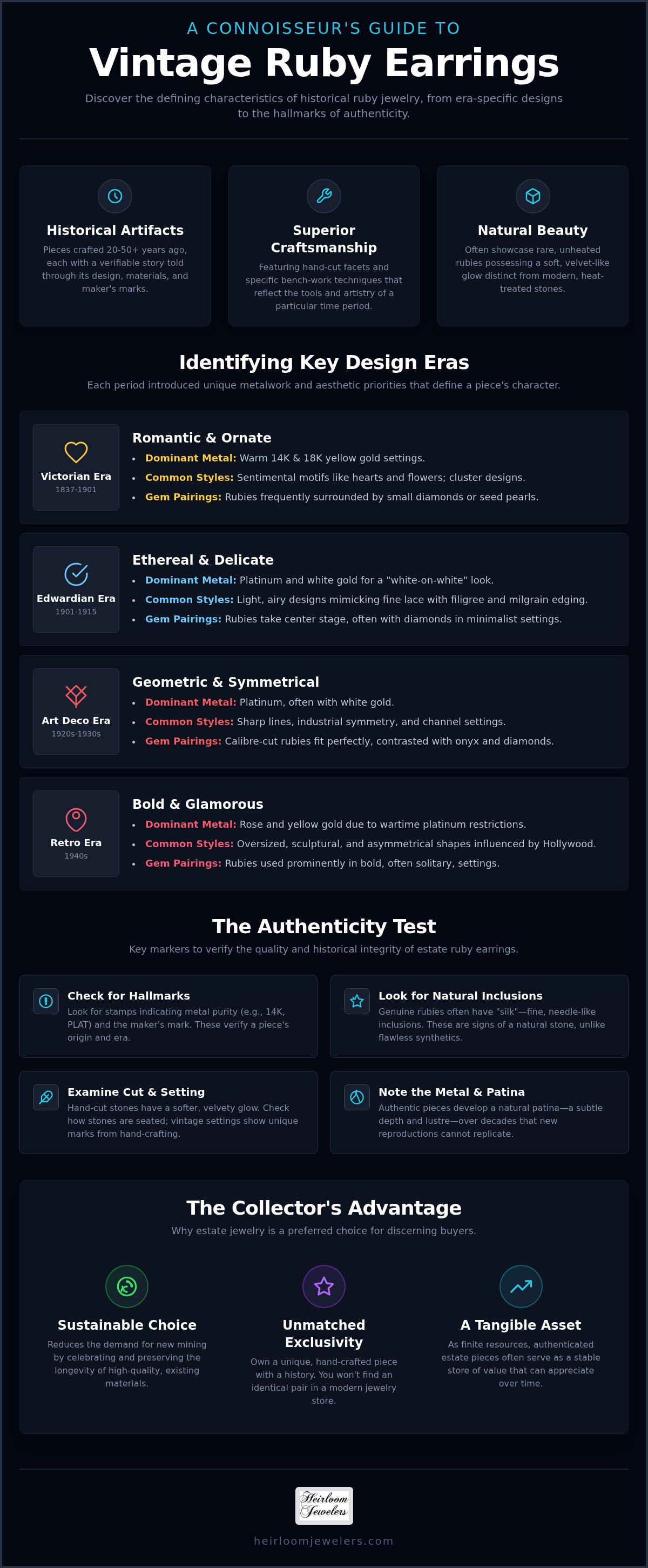
Distinguishing the origin of vintage ruby earrings requires an appreciation for the specific architectural movements of the last two centuries. Each period introduced unique metalwork techniques and aesthetic priorities that define the piece's character. By examining Historical Jewellery Design Eras, collectors can see how social shifts influenced the jeweler's bench. Victorian pieces are recognized by their sentimentality and heavy 14K or 18K yellow gold settings. Edwardian designs introduced the widespread use of platinum, creating an ethereal, lace-like appearance. Identifying these traits helps ensure you are acquiring genuine vintage ruby earrings rather than a modern imitation.
- Victorian Era (1837-1901): Characterized by romantic motifs and cluster designs. These pieces often feature rubies surrounded by small diamonds or seed pearls in high-karat yellow gold.
- Edwardian Era (1901-1915): Known for its "white on white" look. Artisans used platinum to create delicate milgrain edges and filigree that mimicked fine lace.
- Retro Era (1940s): Influenced by Hollywood glamour, these earrings are often oversized. Due to wartime metal restrictions, they frequently utilize rose or yellow gold in bold, sculptural shapes.
The Art Deco Influence on Ruby Designs
The 1920s transformed the silhouette of the ruby earring. Designers moved away from soft Victorian curves toward sharp lines and industrial symmetry. A hallmark of this era is the use of calibre-cut rubies in art deco jewelry. These stones were custom-cut to fit perfectly into geometric channels, often flanked by onyx or diamonds for a striking visual contrast. Look for repeating patterns and a focus on white gold or platinum to identify authentic pieces from this movement. If you're searching for a specific period style, our collection of authenticated estate jewelry offers curated options from these iconic decades.
Victorian vs. Edwardian Ruby Settings
The transition from the 1800s to the early 1900s marked a significant shift in jewelry weight and light interaction. Victorian ruby earrings often feature substantial gold clusters. These settings were frequently closed-back, sometimes with foil behind the stone to enhance its color. In contrast, Edwardian artisans utilized the strength of platinum to create open-back settings. This allowed for better light refraction and a lighter, more delicate feel on the ear. You'll also notice a change in closures. While Victorian styles often use simple kidney wires, Edwardian earrings frequently feature the more secure leverback mechanism. This evolution reflects a move toward both technical refinement and everyday wearability.
Evaluating Quality and Authenticity in Estate Rubies
Authentication is the cornerstone of professional collecting. When you evaluate vintage ruby earrings, you aren't just looking at aesthetic beauty. You are verifying a physical history that must match the stated age of the piece. A professional assessment protects your investment by ensuring the materials are genuine and the craftsmanship is period-correct. This process involves looking beyond the surface to understand how the gemstone was formed and how the setting has aged over decades.
One of the most common surprises for collectors is the presence of early synthetic stones. The Verneuil process, or flame-fusion, became commercially viable around 1902. This means many authentic Art Deco and Retro pieces contain synthetic rubies that were contemporary to the setting. While these are "period-correct" and hold historical interest, they don't command the same market value as natural stones. Identifying these requires a trained eye and specific gemological tools.
To verify a ruby's origin, we look for "silk." These are fine, needle-like inclusions of rutile that occur naturally. Natural rubies typically display straight, angular growth lines. In contrast, synthetic stones from the early 20th century often show curved striae. These are faint, curved lines created during the flame-fusion process. Seeing these details requires at least 10x magnification and proper lighting. It's a technical distinction that significantly impacts the value of vintage ruby earrings.
Inspecting the metal is equally vital for authentication. Genuine estate pieces should bear clear hallmarks that indicate purity. Look for "18K" for gold or "PLAT" for platinum settings. In the early 20th century, 18K white gold became a standard for high-end jewelry. A maker's mark can also increase a piece's value by providing a direct link to a specific workshop. These stamps are often found on the post or the interior of the earring basket.
Natural vs. Period-Correct Synthetic Rubies
Early 20th-century synthetics are fascinating historical artifacts. They allowed for a saturation of color that was difficult to find in nature at an accessible price point. However, their presence must be reflected in the valuation. A natural ruby of the same size and color will always be a more significant investment. Professional jewelers use specialized lighting to reveal the internal structures that separate these two categories, ensuring you know exactly what you're acquiring.
Assessing the Integrity of the Setting
A beautiful stone is only as secure as its setting. You should always check for "prong wear," where the metal has thinned over years of use. If the prongs are too low, the ruby is at risk of falling out. We also look for "marriages," which occur when a stone is swapped into a setting from a different era. Authentic vintage ruby earrings should show consistent wear and style between the gemstone and the metalwork. Check the closures carefully to ensure leverbacks or screw-backs still function with a crisp, reliable snap.
A Buyer’s Guide to Selecting the Perfect Pair
Selecting vintage ruby earrings is a methodical process that balances aesthetic preference with technical verification. We recommend a structured five-step framework to ensure your choice provides both personal satisfaction and investment security. Your selection should integrate seamlessly with your lifestyle while maintaining its historical integrity.
Start by auditing your current wardrobe to determine your era preference. If your style leans toward sharp, geometric silhouettes, Art Deco pieces fit seamlessly. For those who prefer romantic or floral motifs, the Victorian era offers a softer aesthetic. Choosing a period that complements your existing jewelry ensures your new acquisition won't sit forgotten in a box.
Next, consider your metal preference. Platinum and 18K white gold offer a crisp backdrop that emphasizes the ruby's saturation. These metals are ideal for those with cool skin tones or a collection dominated by diamonds. Conversely, yellow or rose gold settings provide a traditional warmth that can make the ruby's red hues appear deeper and more vibrant.
Weight and drop length are critical for daily comfort. A heavy Victorian chandelier earring might be stunning for an evening event, but it may prove impractical for a full day of wear. We suggest testing the weight of similar pieces in your collection before committing to a substantial estate find. Secure closures, such as leverbacks or screw-backs, are also essential for protecting your investment during active use.
Authentication papers or independent lab reports are your greatest safeguard. These documents verify the stone's origin and disclose any treatments. While many vintage pieces don't come with original 19th-century paperwork, modern reports from reputable labs can confirm a stone's natural status. Compare the aesthetic of pure ruby settings to antique diamond earrings. A mixed-gemstone look often provides more versatility for those who wear a variety of metals and styles. If you're ready to find a piece with a documented history, you can browse our authenticated estate jewelry to see these styles in person.
Matching Ruby Hues to Your Style
Rubies range from the intense "Pigeon’s Blood" red to softer pinkish-red tones. This color variation is often tied to the stone's geographic origin. Natural light reveals the true depth of the stone, while indoor incandescent lighting can sometimes shift the perceived hue. Consider whether you prefer the classic simplicity of stud earrings or the dramatic movement of dangle styles. Studs offer a subtle pop of color for professional settings, while dangles allow the stone to catch light from multiple angles.
Budgeting for Authenticated Estate Jewelry
Provenance and condition are the primary drivers of price in the secondary market. Natural rubies that are "unheated" command a significant premium because they are untreated by modern thermal processes. These stones are increasingly rare and highly sought by serious collectors. If you're looking for exceptional value, explore the late Victorian or early Retro periods. These eras often provide high-quality craftsmanship and substantial gold weight at a more accessible entry point than signed Art Deco masterpieces.
Discovering Authenticated Rubies at Heirloom Jewelers
At Heirloom Jewelers, we operate on a philosophy that prioritizes curation over mass-production. We believe that every significant piece of jewelry should possess a distinct identity and a verifiable history. Our collection of vintage ruby earrings is carefully selected to ensure that every pair meets our rigorous standards for material quality and historical significance. We don't engage in modern mass-manufacturing or the creation of replicas. Instead, we act as a bridge between the past and the present, offering unique estate pieces that cannot be found in conventional retail environments.
Purchasing from a trusted authority in heritage jewelry provides a level of security that is essential when navigating the complexities of the secondary market. We understand the nuances of gemstone treatments and the evolution of bench-work techniques. Our focus remains on preserving the integrity of 18K white gold and platinum pieces that have retained their beauty across decades. This commitment to quality ensures that your acquisition serves as both a personal treasure and a meaningful addition to your collection.
Our Curated Authentication Process
Every item in our estate gemstone collection undergoes a methodical inspection before it is presented to our clients. We examine the internal characteristics of every ruby to confirm its natural origin and identify any historical treatments. Our experts also scrutinize the metalwork, verifying that hallmarks and maker's marks align perfectly with the piece's stated era. We focus exclusively on unique pre-owned items because we value the hand-crafted details that modern machinery often overlooks. This transparent process gives our national buyers the confidence to select high-value vintage ruby earrings with complete peace of mind.
A Personal Connection to History
We invite you to explore a collection where every piece carries a story. Our role is to act as your guide through the intricacies of the vintage market, providing the technical expertise needed to make an informed decision. We take pride in our steady and professional atmosphere, avoiding the high-pressure tactics often found in modern retail. Whether you are a seasoned collector or a first-time buyer, we are here to ensure your experience is rooted in an appreciation for fine craftsmanship and heritage. We invite you to explore our current collection of estate ruby earrings and find a piece that resonates with your personal style and history.
Building Your Legacy with Authenticated Heritage Pieces
Selecting the right pair of vintage ruby earrings is an investment in both history and personal expression. We've explored how to identify the geometric precision of the Art Deco movement and the romantic yellow gold clusters of the Victorian era. You now have the framework to distinguish between natural stones with their characteristic silk and the fascinating history of early synthetic gemstones. Understanding these technical nuances allows you to collect with confidence. It's about finding a piece that aligns with your aesthetic while maintaining its historical integrity.
At Heirloom Jewelers, we provide the expertise needed to navigate this complex market. Our collection features expertly curated estate jewelry focusing on authenticated 18K white gold and platinum settings that have stood the test of time. We offer national shipping for high-value heritage pieces, ensuring your selection arrives safely. We invite you to Browse Our Authenticated Collection of Vintage Ruby Earrings and find a piece that resonates with your own story and carries the enduring elegance of a bygone era.
Frequently Asked Questions
What is the difference between antique and vintage ruby earrings?
Antique ruby earrings are pieces crafted at least 100 years ago, currently dating back to 1926 or earlier. Vintage ruby earrings refer to pieces made between 20 and 100 years ago. While terms are sometimes used interchangeably, collectors prioritize these distinctions for valuation and accuracy. Antique styles often feature hand-cut stones and unique metalwork that pre-dates modern techniques, whereas vintage pieces reflect the specific design movements of the mid to late 20th century.
Are lab-grown rubies ever found in authentic vintage jewelry?
Early synthetic rubies are frequently found in authentic jewelry from the early 20th century. The Verneuil flame-fusion process became commercially viable around 1902, leading many Art Deco and Retro artisans to use these stones. While they're contemporary to the setting, they aren't natural gemstones. Collectors often refer to these as "period-correct" synthetics. They hold historical interest but generally command a lower market price than natural, earth-mined rubies from the same era.
How can I tell if my vintage earrings are real 18K white gold?
Identifying 18K white gold begins with a close inspection of hallmarks, typically found on the earring post. Look for stamps like "18K" or "750", which indicate the metal is 75 percent pure gold. Because vintage ruby earrings from the early 20th century often feature these marks, their presence is a strong indicator of quality. If marks have worn away, a professional jeweler can perform a non-destructive test to verify the metal's purity without damaging the piece.
Do vintage ruby earrings hold their value over time?
Vintage ruby earrings generally maintain their value well, particularly when they feature natural, unheated stones. The market for authenticated estate jewelry is driven by scarcity and historical significance. Signed pieces from renowned houses or those with rare "Pigeon's Blood" hues often appreciate as supply diminishes. While market conditions fluctuate, the combination of high-karat gold and rare gemstones provides a stable foundation for value. Investing in pieces with documented provenance further strengthens this financial security.
What should I look for in a hallmark when buying estate jewelry?
When examining estate jewelry, look for three primary hallmarks: purity marks, maker's marks, and occasionally date letters. Purity marks like "PLAT" or "18K" verify the metal content. A maker's mark, which is a unique stamp from the workshop, can significantly increase a piece's value by providing proof of origin. These small engravings are often found in inconspicuous areas. Using a jeweler's loupe is essential for reading these marks clearly without causing any damage to the setting.
How do I clean and care for antique ruby earrings without damaging them?
Cleaning antique ruby earrings requires a gentle touch to protect both the stone and the integrity of the setting. Use warm water mixed with a small amount of mild, detergent-free soap. A soft-bristled toothbrush can carefully remove dust from under the prongs. You should avoid ultrasonic cleaners or steam treatments, as these can dislodge stones or damage fragile antique settings. Always dry the pieces thoroughly with a soft, lint-free cloth to prevent moisture from affecting the metal's patina.
Why are some vintage rubies more pink than red?
The color of a ruby is determined by its chromium content and its geographic origin. Rubies from certain regions, such as Myanmar, often exhibit a vibrant red with a slight pinkish secondary hue. In the gemstone trade, a stone must meet a specific saturation level to be classified as a ruby; otherwise, it's considered a pink sapphire. Many vintage pieces feature these pinkish-red tones because they were highly prized for their brilliance under natural lighting conditions.