
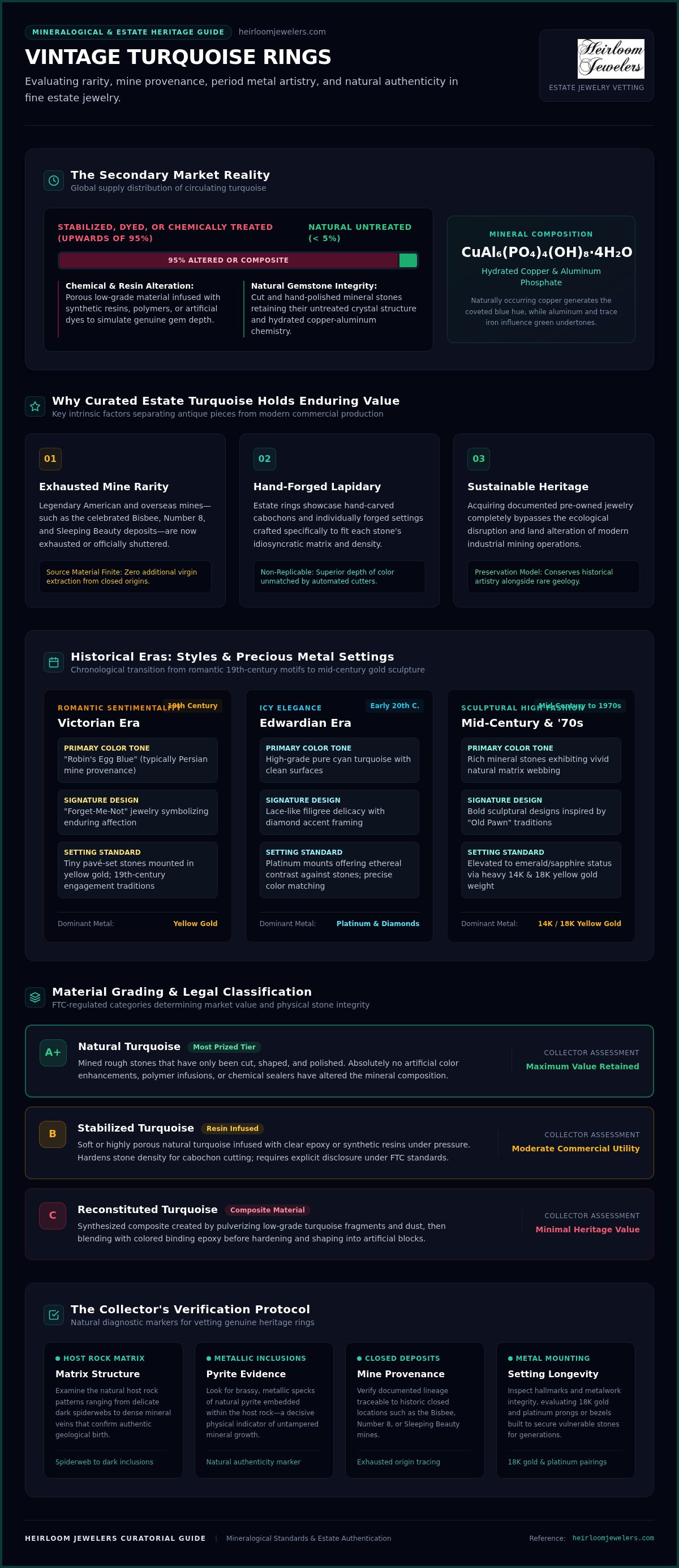
Upwards of 95% of the turquoise circulating in the global market today is stabilized, dyed, or chemically treated. For the serious collector, this reality makes the search for authentic vintage turquoise rings a pursuit that requires both a keen eye and a deep respect for mineralogical history. These pieces represent a rare intersection of geological rarity and cultural artistry; they act as silent witnesses to the specific eras and mines that produced them.
You likely believe that a fine piece of jewelry should hold its value through its integrity and provenance. Acquiring a heritage piece involves looking beyond the surface to understand the specific characteristics of stones from legendary, now-closed locations like the Bisbee or Number 8 mines. This guide provides the essential knowledge needed to identify genuine craftsmanship, evaluate gemstone quality, and distinguish between varied historical styles. We will explore how to interpret hallmarks and navigate the nuances of the secondary market so you can build a collection with absolute confidence. By understanding the distinction between Victorian gold settings and Southwestern silver traditions, you will be prepared to select a piece that balances historical significance with exceptional quality.
Key Takeaways
- Trace the historical transition of turquoise from an ancient protective talisman to a sophisticated centerpiece in Victorian and Edwardian fine jewelry.
- Identify how specific mine provenance, such as the now-closed Bisbee or Sleeping Beauty locations, determines the rarity and market value of vintage turquoise rings.
- Evaluate the relationship between metal settings and gemstone longevity, focusing on the distinct elegance of 18K gold and platinum pairings.
- Use a curator’s checklist to detect natural markers of authenticity, including pyrite inclusions and indicators of untreated mineral surfaces.
- Understand why curated estate turquoise represents a sustainable luxury choice that preserves both historical craftsmanship and geological heritage.
The Historical Significance of Turquoise in Estate Fine Jewelry
Turquoise holds a singular position in the chronicle of human adornment. From the funerary masks of Egyptian pharaohs to the crown jewels of European royalty, this stone has transitioned through millennia as a symbol of power and protection. To understand the history and mineralogy of turquoise is to appreciate its chemical complexity as a hydrated copper and aluminum phosphate. While ancient civilizations viewed it as a protective amulet, the modern secondary market recognizes it as a sophisticated heritage asset. Vintage turquoise rings from prestigious estates often feature hand-carved cabochons that display a depth of color impossible to replicate in modern, mass-produced jewelry. These pieces aren't just accessories; they are historical records of the mines that produced them.
Collectors prioritize these items for several specific reasons:
- Rarity: Many of the world's most famous turquoise mines are now exhausted or closed.
- Craftsmanship: Estate pieces often feature hand-forged settings and custom lapidary work that reflects the era's specific design language.
- Sustainability: Acquiring pre-owned jewelry avoids the environmental impact of new mining operations.
Turquoise in the Victorian and Edwardian Eras
Victorian designers favored the "Robin's Egg Blue" variety, often sourced from Persian mines. This era popularized "Forget-Me-Not" jewelry, where tiny turquoise stones were pavé-set in yellow gold to represent enduring affection. It was a staple in 19th-century engagement traditions. As the Edwardian period emerged, the aesthetic shifted toward a lace-like delicacy. Designers began pairing high-grade turquoise with platinum and diamonds. These pieces emphasized a cool, ethereal palette that highlighted the stone’s smooth texture against the icy brilliance of precious metals. The craftsmanship was meticulous. Every stone was hand-selected to ensure a perfect color match across the setting.
The Mid-Century Modern and Southwestern Influence
The 20th century brought a dramatic stylistic evolution. While early Southwestern pieces were primarily set in silver, the mid-century era saw a transition toward 14K and 18K yellow gold settings. This shift elevated the stone to the level of emeralds and sapphires in high-fashion circles. The 1970s marked a significant resurgence, characterized by bold, sculptural designs and heavy gold work. Designers drew inspiration from "Old Pawn" traditions, which emphasized substantial metal weight and untreated stones. These vintage turquoise rings offer a quiet confidence, bridging the gap between rugged naturalism and refined luxury. Collectors today value these pieces for their unique matrix patterns and the weight of the history they carry.
Identifying Mine Provenance: The Collector’s Guide to Color and Matrix
In the secondary market, the mine of origin serves as the most critical variable in determining a stone's value. Provenance is the documented history of a gemstone’s origin and ownership. For vintage turquoise rings, establishing this lineage ensures that the piece is a genuine artifact rather than a modern imitation. The host rock, or "matrix," provides the primary visual evidence of a stone's birthplace. These patterns range from delicate spiderwebs to heavy, dark inclusions that define the stone's character. Understanding GIA turquoise quality factors helps collectors evaluate how color saturation and matrix symmetry impact overall desirability.
Distinguishing between material grades is essential for any serious acquisition. Natural turquoise remains the most prized tier, representing stones that have been cut and polished without chemical alteration. Stabilized turquoise involves the infusion of clear resins to harden porous material, while reconstituted turquoise is a composite of crushed fragments and epoxy. Federal Trade Commission standards require the explicit disclosure of these treatments. If you're looking to add an authentic piece to your portfolio, exploring a curated estate jewelry collection ensures you are viewing pieces that have been professionally vetted for integrity.
Famous American Turquoise Mines
The American Southwest is home to several legendary deposits that are now closed to commercial mining. The Sleeping Beauty mine in Arizona, which ceased operations in August 2012, is famous for its matrix-free, sky-blue color. In contrast, Bisbee turquoise is recognized by its deep blue hue and distinct "chocolate" or smoky lavender matrix. This mine has been closed since 1975, making authentic specimens increasingly rare. The Lander Blue mine in Nevada remains the ultimate prize for collectors. It produced less than 110 pounds of material in its lifetime, characterized by an exceptionally fine, tight spiderweb matrix.
Persian and Egyptian Turquoise
European estate jewelry often features turquoise from the Neishabur district of Iran, historically known as Persian turquoise. These stones are typically denser and more lustrous than American varieties, often lacking any visible matrix. This "Persian Blue" was the gold standard for Victorian royalty and remains highly sought after for its porcelain-like finish. Sinai turquoise, found in antique Mediterranean rings, often carries a more yellowish-green cast. These Egyptian stones hold immense historical significance, as they were among the first gemstones ever mined by human civilizations.
Evaluating the Artistry: Period Styles and Metal Settings
Metal selection defines the character and enduring value of vintage turquoise rings. While many collectors associate this gemstone with sterling silver, the most prestigious estate pieces often utilize 18K yellow gold or platinum. Yellow gold provides a warm, classic contrast that deepens the visual richness of the turquoise, creating a traditional "heritage" look. Conversely, platinum offers a cool, architectural elegance that highlights the stone's saturation without distraction. For a comprehensive look at how these materials have been used throughout history, you may explore The Timeless Artistry of Antique Rings.
Hand-fabricated settings remain superior to modern cast mountings. In vintage jewelry, a setting was often built specifically to accommodate the unique dimensions of a hand-cut cabochon. This bespoke approach ensures a secure fit and a structural integrity that mass-produced items lack. When sourcing pieces with tribal associations, it's helpful to reference federal buying tips for authentic Native American jewelry to ensure the provenance meets legal and ethical standards. This level of scrutiny distinguishes a serious collection from a casual one.
Art Deco Geometry and Turquoise
The 1920s introduced a geometric rigor to turquoise jewelry. Designers often incorporated the stone into "tutti frutti" arrangements or intricate mosaic patterns. High-contrast combinations were a signature of the era. Pairing vibrant blue turquoise with black onyx or brilliant-cut diamonds created a sophisticated Jazz Age aesthetic that felt both exotic and modern. These pieces moved away from the organic curves of the previous century toward sharp, clean lines. You can learn more about the specific hallmarks of this movement in our Art Deco Jewelry Guide.
Retro and Mid-Century Cocktail Rings
The 1940s and 50s ushered in a "big and bold" philosophy. Cocktail rings became a centerpiece of social expression during this period. Large turquoise cabochons were frequently set in heavy 14K or 18K rose and yellow gold to create a sense of theatrical glamour. This "Hollywood Regency" influence brought organic "nugget" textures and sculptural metalwork that wrapped around the stone. These mid-century vintage turquoise rings prioritize presence and personality. They represent a transition from the structured Art Deco period to a more expressive, fluid form of luxury that remains highly collectible today.
The Collector’s Checklist: Authenticity, Condition, and Hallmarks
Evaluating vintage turquoise rings requires a methodical inspection of both the gemstone and the metalwork. Because turquoise is a porous mineral, its condition often reflects its history of wear and care. Exposure to skin oils, perfumes, or household chemicals can lead to permanent discoloration; this often shifts a blue stone toward a duller green over several decades. Beyond color, you should check for bezel tightness and matrix stability. A stone that wiggles in its setting or shows fine cracks in the host rock may require professional attention to prevent loss. Identifying "pyrite" inclusions is also a helpful skill. These brassy, metallic specks are often referred to as "fool's gold" and serve as a reliable signature for authentic material from mines like Morenci. A hallmark is an official mark stamped on precious metals to certify purity and origin.
Reading the Metal Hallmarks
Most high-value estate rings feature stamps on the inner band that provide vital data about the piece's construction. You'll likely see "18K" or "750" for 18-karat gold, or "Plat" for platinum. It's essential to distinguish between these purity marks and the maker's mark, which identifies the specific artisan or jewelry house. Hallmarking standards vary by country and era. British estate pieces, for instance, often carry a series of stamps indicating the assay office and the year of manufacture. Understanding these symbols allows you to date a piece accurately and confirm its historical context. For more details on inspecting metal integrity, see our Buying Guide to Vintage Engagement Rings.
Detecting Treatments and Enhancements
Natural turquoise is increasingly rare in the modern market. It typically commands a 3x to 10x price premium over stabilized stones because it hasn't been chemically altered to improve its durability or color. While some suggest the "hot needle test" to detect resins, this method is destructive and unreliable for high-value items. Professional gemological observation is the only safe way to verify if a stone is untreated. Before purchasing, ask the jeweler if the stone is "natural," "stabilized," or "reconstituted." Reconstituted material, made from crushed dust and epoxy, lacks the value and longevity of genuine mineral specimens. You should also inquire if the cabochon has a "backing," which is a support layer used during the cutting process. If you are ready to acquire a piece of verified heritage, you can view our authenticated estate jewelry.
Investing in Heritage: Why Curated Estate Turquoise Endures
Owning a heritage piece is an exercise in quiet confidence. It's a decision to prioritize material integrity and historical significance over fleeting trends. Vintage turquoise rings offer a finite supply of stones from legendary, exhausted mines. The closure of the Sleeping Beauty mine in 2012 and the Bisbee mine in 1975 transformed their outputs into finite resources. These pieces are rare collector assets that cannot be replicated by modern mass production. Choosing estate jewelry is also a choice for sustainable luxury. You preserve the craftsmanship of the past while eliminating the environmental footprint of new mining operations.
Heirloom Jewelers acts as a bridge between historical eras and modern wearability. We curate pieces that demonstrate exceptional lapidary work and structural longevity. Our focus remains on high-value items set in 18K gold and platinum settings. This ensures each ring is worthy of its status as a heritage gemstone. By selecting pieces with unique matrix patterns and superior metalwork, we provide our clients with jewelry that holds its value and its beauty across generations.
The Value of Authenticated Provenance
A documented history safeguards the resale and emotional value of your acquisition. Provenance provides verification that a stone is natural and untreated. This is crucial in a market where the vast majority of turquoise has been stabilized or chemically altered. A trusted jeweler serves as an essential guide in this process. They verify the era and material quality through professional observation and industry expertise. To understand these categories of fine jewelry better, read our guide on What is Heritage Jewelry?
Starting Your Collection with Heirloom Jewelers
Transitioning into collecting begins with an "anchor" piece. This ring should embody your aesthetic while meeting strict criteria for gemstone quality and metal purity. Unverified auction sites often lack the authentication required for high-value investments. Professional estate jewelers provide a secure environment where every hallmark and matrix pattern is scrutinized for accuracy. We invite you to explore our curated collection of authenticated estate and vintage rings to find a piece that resonates with your personal history.
Building Your Personal Jewelry Heritage
Selecting a fine estate piece requires a balance of historical appreciation and technical scrutiny. You now understand how mine provenance defines a stone's rarity and market value. Identifying natural, untreated stones and interpreting the hallmarks on 18K gold or platinum settings ensures your acquisition remains a sound investment. Vintage turquoise rings are more than simple adornments; they are tangible connections to specific geological eras and artistic movements.
As you expand your collection, remember that the most meaningful pieces combine exceptional craftsmanship with verified authenticity. Heirloom Jewelers serves as a trusted authority in the heritage market, specializing in high-end authenticated estate jewelry. Our experts carefully curate every item to ensure it meets our standards for material quality and historical significance. This methodical approach allows you to acquire one-of-a-kind pieces with absolute confidence.
Browse Our Curated Collection of Authenticated Vintage and Estate Rings to find a piece that reflects your unique style. We look forward to helping you discover a jewel that carries a legacy of its own.
Frequently Asked Questions
Is turquoise a good stone for an engagement ring?
Turquoise is a meaningful choice for an engagement ring but requires careful consideration due to its hardness. It ranks between 5 and 6 on the Mohs scale, making it softer than diamonds or sapphires. This means it's susceptible to scratching and chemical damage from daily wear. For those seeking durability in a bridal piece, a vintage platinum setting offers superior protection for the stone compared to lighter mountings.
How can I tell if my vintage turquoise ring is real or synthetic?
Professional gemological observation is the only definitive way to distinguish natural material from synthetic or imitation stones like dyed howlite. Authentic vintage turquoise rings often display a complex matrix of host rock and subtle color variations that lab-grown alternatives lack. You should also examine the weight and temperature of the piece. Genuine stone feels cool to the touch and carries more heft than plastic-based block turquoise.
What is "Sleeping Beauty" turquoise and why is it so expensive?
Sleeping Beauty turquoise originates from a specific mine in Globe, Arizona, that ceased turquoise production in August 2012. It's highly valued for its uniform, sky-blue color and characteristic lack of matrix. Because the mine now focuses exclusively on copper, the global supply of this material is finite. Collectors pay a premium for authenticated, untreated specimens due to their scarcity in the secondary fine jewelry market.
Does vintage turquoise change color over time?
Yes, natural turquoise is a porous phosphate mineral that can absorb external substances. Over several decades, exposure to skin oils, soaps, and perfumes can cause a chemical reaction that shifts the stone’s color from bright blue to a darker green or teal. This shift is often viewed by collectors as a natural patina that confirms the age and authenticity of a genuine estate piece rather than a defect.
What should I look for in the hallmarks of a vintage turquoise ring?
You should look for stamps that certify the metal purity and identify the maker. Common hallmarks include 18K or 750 for gold and Plat or 950 for platinum. In vintage turquoise rings, these marks are typically found on the interior of the band. A clear, well-defined hallmark suggests high-quality craftsmanship, while the absence of marks in older pieces may indicate a custom, hand-forged origin or coin-silver construction.
How do I clean and care for an antique turquoise ring without damaging it?
Clean your ring using only a soft, dry cloth or a slightly dampened cloth with mild, additive-free soap. Never submerge the piece in water or use ultrasonic cleaners, as the vibrations and heat can fracture the stone or damage the setting. Avoid contact with hairspray, lotions, and household cleaners. Storing your jewelry in a fabric-lined box away from direct sunlight helps preserve the stone's moisture balance and color over time.
What is the difference between "natural" and "stabilized" turquoise?
Natural turquoise is simply cut, polished, and set without any chemical alterations. Stabilized turquoise has been treated with clear resin or epoxy to fill its pores, making the stone harder and less likely to change color. While stabilization is a standard industry practice for durability, natural, untreated stones are significantly rarer. These untreated specimens command much higher prices among enthusiasts who value mineralogical purity and historical integrity.
Why is some turquoise green while other stones are bright blue?
The color of turquoise is determined by the presence of specific minerals during its formation. A high copper content results in the classic bright blue hue, while the presence of iron or aluminum shifts the stone toward green or yellowish tones. Different mines produce distinct color profiles. For instance, Persian mines are legendary for deep blues, while certain Nevada mines are prized for their unique, earthy green variations and complex matrix patterns.