
A modern diamond is a product of precision engineering, but a one carat vintage engagement ring is a work of hand-carved history. While contemporary brilliant cuts prioritize mathematical symmetry, antique stones were shaped by the human eye to dance under candlelight. These hand-cut facets offer a visual depth that modern lasers cannot replicate. You've likely felt the pull toward a piece with a soul, yet the market is crowded with mass-produced replicas that lack the character of a true antique. It's natural to feel uncertain about whether a century-old setting remains durable or how an Old European cut compares to the rigid grading standards of today.
This guide provides the clarity you need to secure an authentic 1.00ct+ center stone that carries genuine historical value. You'll discover the unique character of heritage cuts, the lasting strength of platinum settings from the 1920s, and the specific criteria used to authenticate estate jewelry. We'll bridge the gap between historical craftsmanship and your modern romance. By understanding the nuances of the secondary market, you can find a one-of-a-kind treasure that serves as both a beautiful symbol and a lasting legacy.
Key Takeaways
- Distinguish between true antique settings and modern replicas by understanding the historical rarity of one-carat stones.
- Learn to identify the unique visual depth of Old European and Old Mine cuts, which were hand-carved to maximize light in candlelight.
- Understand why a one carat vintage engagement ring offers superior historical character and sustainability compared to mass-produced modern alternatives.
- Master the basics of authentication by checking for specific metal hallmarks and maker's marks that verify a piece's age and origin.
- Discover how to secure high-value estate jewelry through a reliable process focused on integrity and historical preservation.
The Significance of the One Carat Vintage Engagement Ring
A one carat vintage engagement ring represents a specific intersection of historical craftsmanship and gemstone rarity. In the jewelry trade, this refers to a diamond weighing exactly 100 points, or one carat, housed within an authentic setting from the Victorian, Edwardian, Art Deco, or Mid-Century eras. While modern technology allows for the mass production of large stones, a vintage one-carat diamond is a finite relic. Reaching the one-carat mark has long been a psychological milestone in engagement traditions. It signals a level of commitment and stability that has resonated through decades of romantic history. Choosing this weight in a vintage piece favors character and provenance over the standardized uniformity of modern retail.
Why One Carat is a Milestone in Estate Jewelry
During the early 20th century, sourcing a high-clarity diamond of this size was significantly more difficult than it is today. In the Art Deco period, a one-carat stone was a luxury reserved for the elite. These diamonds weren't cut by programmed lasers; they were shaped by master lapidaries who understood the nuances of light. Understanding Historic Diamond Cuts reveals how the evolution of these techniques prioritized personality over modern symmetry. In the 1920s, a stone of this magnitude was often the centerpiece of a family's wealth. Owning such a piece today provides heirloom value that transcends simple market pricing. It's a preserved fragment of history that carries the weight of past generations, offering a connection to the craftsmanship of a century ago.
The Aesthetic Difference: Carat Weight vs. Visual Impact
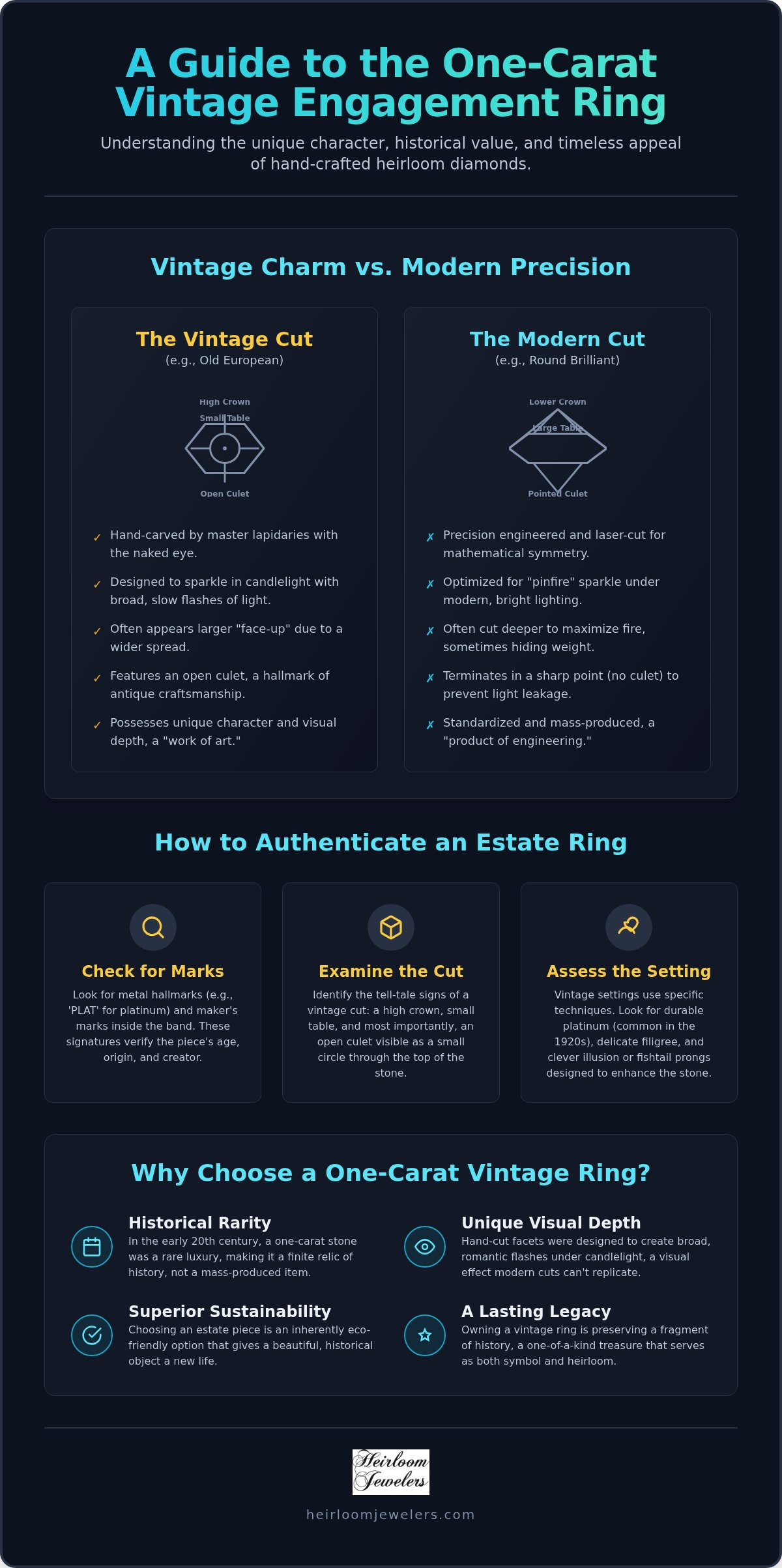
Carat weight measures mass, not necessarily size. Vintage diamonds often feature a different "face-up" appearance compared to modern brilliant cuts. Because they were hand-cut, some stones possess a broader "spread," making the one carat vintage engagement ring appear larger than its modern counterparts. This visual impact is a result of how the stone was proportioned to catch low light. Modern stones are often cut deep to maximize "fire," which can sometimes hide weight below the girdle. In contrast, vintage cuts like the Old European often present a more substantial silhouette.
Jewelers in the 1930s and 40s often used clever setting techniques to enhance this visual presence. For example, fishtail prongs or illusion settings use reflective metal to extend the diamond's perimeter. This creates a sense of grandeur without the aggressive "bling" common in modern jewelry. The result is a look of quiet elegance. It favors the subtle interplay of light and shadow over the high-intensity sparkle of contemporary machine-cut stones. These settings don't just hold the stone; they celebrate it as a unique piece of art.
Understanding Historic Diamond Cuts: Old European and Old Mine
The beauty of a one carat vintage engagement ring often lies in the specific geometry of its center stone. Before computer-aided design, master cutters relied on their eyes to maximize a diamond's beauty. The Old Mine Cut is the oldest style typically found in estate jewelry. It features a soft, squarish "cushion" shape, a small table, and a notably high crown. As cutting technology improved in the late 19th century, the Old European Cut (OEC) emerged. This cut transitioned the diamond into a more circular shape. It remains the direct ancestor of the modern round brilliant, yet it retains a personality that machine-cut stones cannot mimic.
Authentic vintage stones are easily identified by the presence of an open culet. This is the flat facet at the base of the diamond. While modern diamonds terminate in a sharp point, older stones have a visible facet that creates a small "hole" or circle when viewed through the top of the stone. This was a functional choice by early lapidaries. It prevented the bottom of the diamond from chipping during the setting process. Today, this feature is a celebrated hallmark of antiquity.
The Mechanics of "Inner Fire" in Vintage Diamonds
Light performance in vintage diamonds is distinct. Modern cuts are engineered for "pinfire" sparkle, which consists of many tiny, rapid flashes of light. Vintage cuts produce "broad flashes" of light. These larger, slower reflections were specifically designed to perform under the warm, flickering glow of candlelight. The "kozibe" effect is a unique phenomenon in Old European Cuts where the culet is reflected multiple times in the crown facets, adding a layer of visual complexity. Citing The Significance of the One Carat Vintage Engagement Ring shows how these aesthetic choices were dictated by the social environments of the era.
The Geometry of Art Deco and Edwardian settings
Selecting a one carat vintage engagement ring from the Art Deco period ensures a piece with structural integrity and artistic flair. These settings often integrated stones into highly architectural art deco jewelry. Designers used milgrain and filigree to add texture without adding bulk. Platinum became the standard for high-end engagement rings in the 1920s. Its strength allowed jewelers to create delicate, airy designs that could securely hold a one-carat stone. This metal does not tarnish and maintains a crisp, white luster that enhances the diamond's natural color.
Our curators prioritize stones that exhibit these specific historic characteristics. You can explore our curated inventory to see how these hand-cut diamonds interact with light in person.
Vintage vs. Modern: Evaluating the One Carat Choice
Choosing a one carat vintage engagement ring is a departure from the commodity-driven world of modern retail. In a typical jewelry store, diamonds are often sold based on a spreadsheet of lab results. Vintage pieces operate on a different set of values. A common objection is that antique diamonds are "worse" because they don't meet modern GIA "Ideal" cut standards. This is a misunderstanding of the craft. Modern standards were developed for modern round brilliants, which are designed to reflect light in a specific, uniform way. Applying these rules to a 100-year-old stone ignores the intended artistry of the era. It's like judging a classic oil painting by the pixel density of a digital photograph.
Value retention is another critical factor. New retail diamonds often lose a significant percentage of their value the moment they leave the store. Vintage rings have already survived the initial retail markup of their original era. They're historical assets that tend to hold their value because their supply is finite. You're investing in a piece that has already proven its enduring appeal over several decades.
The Sustainability of Heritage Diamonds
For the modern couple, estate jewelry represents the most ethical choice available. Choosing a pre-owned ring eliminates the need for new mining, reducing the environmental footprint of your purchase to nearly zero. This concept of "re-circulated luxury" ensures that beautiful craftsmanship continues to be appreciated rather than sitting in a vault. By selecting heritage jewelry, you're participating in a sustainable cycle that honors the past while protecting the future. It's a choice that aligns personal values with timeless elegance without compromising on quality.
Grading Nuances: Why the 4Cs Don’t Tell the Whole Story
While the 4Cs provide a helpful framework, they don't capture the essence of a vintage stone. A "Very Good" cut grade is often impossible for a hand-faceted stone from 1910. Instead, we look for the 5th and 6th Cs: Character and Personality. We often find that color grades in the K to M range possess a desirable "warmth" in a one carat vintage engagement ring. This creamy tint complements the intricate metalwork of Art Deco or Victorian settings, whereas a stark white D-color stone might look out of place. We encourage collectors to prioritize "eye-clean" stones over perfect clarity grades. Small, natural inclusions are often hidden within the broad facets of an Old European cut, making a stone with character a far more compelling choice than a sterile, lab-perfect diamond. For those who are also considering modern loose stones with high visual performance, Superlight Diamonds specializes in clarity-enhanced options that offer impressive brilliance and value.
The marketplace for a one carat vintage engagement ring is often diluted by modern replicas. These "vintage-style" pieces are mass-produced to look old, but they lack the structural soul of a true antique. Authentication requires a methodical eye. You aren't just looking for beauty; you're looking for evidence of a jeweler's hand. True vintage pieces often show subtle signs of a life lived. These might include tiny scratches on the metal or prongs that have been carefully retipped over the decades. Unlike a sterile modern casting, authentic antique rings possess a weight and texture that feels intentional. It's a mark of integrity that a replica simply can't achieve.
Independent appraisals are essential for high-value estate transactions. A professional gemologist will verify that the setting and the stone originate from the same era. They'll also check for "married" pieces, where a modern diamond has been placed into an old setting. While these can be beautiful, they don't carry the same collector value as a period-correct original. We recommend seeking documentation that confirms the stone's cut and the metal's purity before finalizing your purchase.
Inspecting the Setting: Platinum and Gold Hallmarks
Metal hallmarks provide the most immediate evidence of age. You'll typically find these stamps on the inner band of vintage engagement rings. American pieces from the early 20th century often feature "PLAT" for platinum or "18K" for gold. European estate jewelry might use decimal numbers like .950 for platinum or .750 for 18K gold. Maker's marks are equally important. These small symbols or initials identify the specific design house or jeweler responsible for the work.
Don't be deterred by a dull, greyish finish on a platinum band. This is known as patina. It's a natural result of the metal's durability and daily wear. Many collectors prefer this soft glow over a high-polish finish because it proves the ring's age. Polishing it away can actually decrease the historical value of the piece. It's a testament to the metal's strength and its ability to protect a one carat vintage engagement ring for a century or more.
Verifying the Center Stone: GIA and Beyond
Verifying the diamond involves more than just checking its weight. Follow these steps to ensure your stone is an authentic vintage cut:
- Step 1: Review the Certification. A GIA report should specify the cut as "Old European" or "Circular Brilliant." If a report only lists "Round Brilliant," the stone may be a modern replacement.
- Step 2: Use a Jeweler's Loupe. Look for the large, flat culet and steep crown angles discussed earlier. These features are difficult to replicate with modern laser-cutting tools.
- Step 3: Analyze the Metalwork. Examine the decorative piercing. Authentic vintage settings feature "hand-sawed" edges that are crisp and angular. Modern replicas are usually molded, resulting in rounded, soft edges inside the decorative gaps.
Our curators personally inspect every piece to ensure these historical standards are met. You can view our authenticated estate collection to find a piece that has been verified for both quality and provenance.
Selecting Your Heirloom at Heirloom Jewelers
Heirloom Jewelers acts as a bridge between the artistry of the past and the milestones of your present. We believe that a one carat vintage engagement ring should be as unique as the story it represents. Our commitment to integrity means every piece in our inventory has been authenticated for its historical accuracy and material quality. We don't settle for "vintage-inspired" replicas. Instead, we offer genuine artifacts that have endured for generations. This dedication ensures that when you choose a piece from our collection, you're securing a tangible link to jewelry history. We treat every estate find as a preserved treasure, maintaining its original character while ensuring it's ready for a lifetime of wear.
The Curation Process: Beyond Mass-Produced Jewelry
Our selection criteria are rigorous. We explicitly avoid modern mass-produced jewelry, focusing instead on the secondary market's most exceptional finds. Every one-carat diamond in our inventory undergoes a careful evaluation to ensure it possesses the "inner fire" and character discussed in previous sections. This curated approach means our collection is small but significant. It offers the quiet confidence that comes with owning a ring with no duplicate. Beyond our rings, we apply this same standard to our selection of antique diamond earrings and estate necklaces. We only sell what we would be proud to collect ourselves, prioritizing stones with unique faceting and settings that showcase master-level metalwork.
Global Expertise, National Trust
Acquiring a high-value estate piece requires a partner you can trust. While we function as a local authority, our reach extends to collectors across the country. We've developed secure, fully insured shipping protocols to ensure your one carat vintage engagement ring arrives safely at your door. Every shipment is handled with the same respect we show the jewelry itself, using discreet packaging and professional couriers. If you're evaluating the complexities of a one-carat purchase for the first time, our specialists are available for personal consultations. We provide the transparent information you need to make an informed decision without the pressure of modern retail tactics. We believe in building long-term relationships based on reliability and shared appreciation for fine jewelry.
Our goal is to help you find a piece that resonates with your personal style while honoring the craftsmanship of the early 20th century. We invite you to Explore our curated collection of one-carat vintage engagement rings and discover the timeless elegance of a true heirloom.
Secure Your Piece of Jewelry History
Choosing a diamond with a century of history is an investment in both character and craftsmanship. You've seen how the hand-faceted geometry of Old European cuts creates a visual depth that modern machine-cut stones can't match. By prioritizing authentic hallmarks and period-correct settings, you ensure your piece is a genuine artifact rather than a mass-produced imitation. This path offers a sustainable way to celebrate your future while honoring the artistry of the past. It's a choice that favors personality over standardized retail trends.
At Heirloom Jewelers, we act as authenticated estate jewelry specialists. We exclusively curate antique and vintage pieces that meet the highest standards of integrity. Our team verifies the provenance of every one carat vintage engagement ring in our collection, ensuring you receive a one-of-a-kind treasure. We support our clients with secure national insured shipping and professional guidance throughout the selection process. Your journey toward owning a masterpiece should be as steady and respectful as the jewelry itself.
View Our Authenticated Collection of One Carat Vintage Engagement Rings
The right heirloom is more than a purchase; it's a legacy. We look forward to helping you find the perfect symbol for your modern romance.
Frequently Asked Questions
Is a one-carat vintage diamond more expensive than a modern one?
Vintage diamonds often provide a more accessible entry point into high-quality stones because they've already moved through the primary retail market. While a modern diamond carries the cost of contemporary mining and marketing, an estate stone represents recirculated luxury. Prices vary based on the rarity of the cut and the condition of the setting. A unique Art Deco piece might cost more than a generic modern solitaire, but the historical value is incomparable. For those who prioritize the specific sparkle of contemporary cuts, visiting Robson's Jewelers to browse a selection of engagement rings Baytown TX is an excellent way to compare modern mined and lab-grown diamonds side-by-side.
Authentic pieces exhibit specific indicators of hand-craftsmanship that modern replicas cannot easily mimic. Inspect the inner band for period-correct hallmarks such as "PLAT" or early maker's marks. True vintage settings often feature crisp, hand-sawed filigree and milgrain detailing. Replicas typically use casting molds, which leave soft or rounded edges within the decorative gaps. Examining these structural nuances with a jeweler's loupe provides the clearest evidence of a piece's historical origin.
Can I resize a one-carat vintage platinum ring?
Most platinum settings from the early 20th century are durable enough for resizing by a specialist. Platinum doesn't lose metal when scratched or worked, making it ideal for restoration. However, if the band features continuous engraving or delicate filigree, a resize might interrupt the pattern. A knowledgeable jeweler will assess the structural integrity of the shank before proceeding. It's important to preserve the original patina and hallmarks during any professional adjustment to maintain historical value.
What is the most popular era for one-carat vintage engagement rings?
The Art Deco era remains the most popular period for collectors today. During the 1920s and 1930s, jewelers mastered the use of platinum to create architectural, geometric settings. These designs were specifically engineered to highlight the presence of a 1.00ct center stone. The Edwardian era is also highly prized for its delicate, lace-like filigree work. Each period offers a distinct aesthetic that reflects the social and artistic movements of its time, making a one carat vintage engagement ring from this era a coveted choice.
Does a vintage diamond have the same sparkle as a modern brilliant cut?
Vintage diamonds possess a distinct light performance characterized by "broad flashes" rather than the rapid "pinfire" sparkle of modern cuts. These stones were hand-faceted to maximize beauty in low-light environments, such as candlelight. While a modern brilliant cut is engineered for high-intensity white light, an Old European cut offers a deeper, more romantic glow. This unique interaction with light is often what draws collectors to a one carat vintage engagement ring over contemporary alternatives.
Are one-carat estate rings safe for everyday wear?
Estate rings are remarkably resilient, particularly those crafted in platinum or 18K white gold. These materials were selected by historic jewelers for their ability to securely hold precious stones over decades of use. While the settings are durable, the intricate filigree and milgrain work requires respectful care. We recommend regular inspections to ensure prongs remain tight. With proper maintenance, a century-old ring is perfectly suited for daily wear and continued preservation as a future heirloom.
Should I look for a GIA certificate for a vintage diamond?
Obtaining a GIA report is a prudent step when purchasing a 1.00ct+ estate stone. The Gemological Institute of America provides an objective assessment of the diamond's natural origin and its specific cut style. A certificate will formally identify the stone as an "Old European" or "Old Mine" cut, which is essential for verifying authenticity. This documentation ensures you're investing in a genuine piece of history rather than a modern stone that has been recut to look old.
What is the difference between an Old European cut and an Old Mine cut?
The primary difference lies in the shape and the era of production. Old Mine cuts, popular in the 18th and 19th centuries, feature a squarish, cushion-like silhouette with a high crown. Old European cuts emerged later as cutting technology improved, offering a rounder shape that eventually led to the modern brilliant cut. Both styles feature the characteristic large facets and open culets that define antique diamonds. Choosing between them depends on whether you prefer a geometric or circular aesthetic.