
A modern factory can replicate a design, but it can never manufacture a century of history. For many collectors, the appeal of one-of-a-kind vintage diamond rings lies in their refusal to be duplicated. You've likely felt the frustration of searching for something truly unique only to find mass-produced "vintage-style" replicas that lack character. It's common to feel uncertain about the durability of an older platinum setting or the specific geometry of an antique diamond cut compared to a modern brilliant.
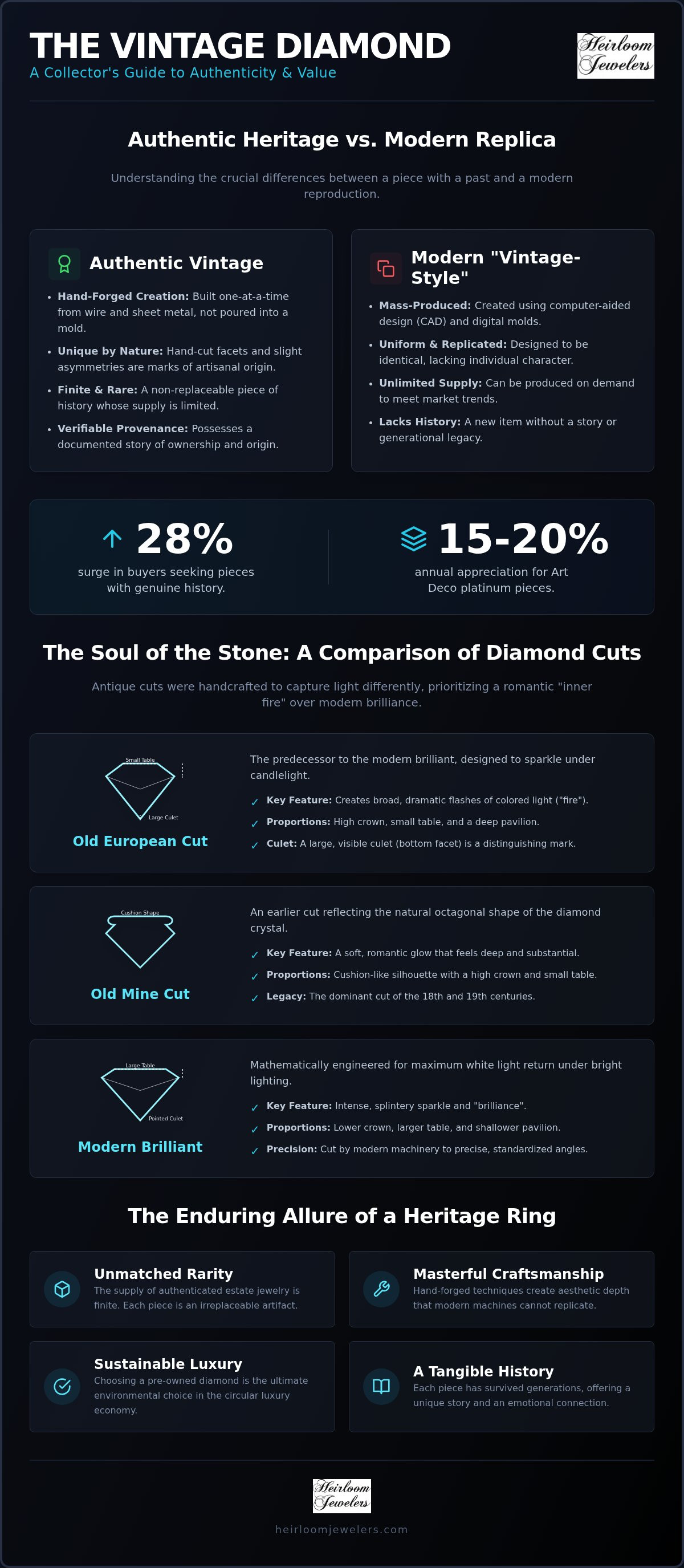
In 2026, there's been a 28% surge in buyers seeking pieces with genuine history. This shift reflects a growing desire for the sustainability and artisanal soul found in authenticated estate jewelry. This guide will clarify the historical significance and craftsmanship of these rare finds. You'll learn how to identify authentic hand-cut facets and why Art Deco platinum pieces are currently appreciating by 15 to 20% annually. We'll show you how to secure a high-quality diamond with a story that belongs only to you.
Key Takeaways
- Distinguish between mass-produced "vintage-style" jewelry and authentic heritage pieces defined by their specific era and artisanal origin.
- Identify the unique "inner fire" and hand-cut facet patterns of Old European and Mine cuts that characterize one-of-a-kind vintage diamond rings.
- Understand the superior material integrity of high-purity platinum and the distinct luster of mid-century 18K white gold settings.
- Learn how to verify the provenance and authenticity of estate jewelry through specialized appraisals and secondary market expertise.
- Explore the environmental advantages of the circular luxury economy by choosing high-end pre-owned diamonds over newly mined alternatives.
Defining the One-of-a-Kind Vintage Diamond Ring
True rarity isn't just a marketing claim. It's the intersection of a specific historical era, the hand of a master artisan, and a unique geological discovery. One-of-a-kind vintage diamond rings are distinct from modern "vintage-style" jewelry. While modern pieces are often mass-produced using digital molds, authentic vintage rings were created one at a time. They represent a curated legacy, offering a steady alternative to the ephemeral trends of modern retail.
The structural integrity of one-of-a-kind vintage diamond rings comes from labor-intensive processes. An Edwardian or Art Deco ring was built from wire and sheet metal rather than being poured into a mold. This results in a level of aesthetic depth that computer-aided design cannot replicate. These hand-forged techniques have largely vanished from contemporary manufacturing, making every surviving piece a finite resource.
The Difference Between Bespoke and Authentic Vintage
It's helpful to distinguish between bespoke and vintage. A bespoke ring is "made for one," commissioned to fit a specific vision. An authentic vintage ring has "survived as one." It has endured through decades or centuries to reach the present day. This survival adds a layer of historical significance that new items lack.
For example, hand-engraved filigree from the 1920s possesses tiny irregularities that give it life. These details cannot be perfectly mimicked by 3D printing. The tools used by artisans a century ago left distinct marks that modern machines don't produce. Owning a piece that has survived generations provides an emotional connection that new jewelry simply doesn't offer.
Why Rarity is the Ultimate Luxury
Rarity is the foundation of value in the secondary market. The supply of authenticated estate jewelry is finite. Unlike modern retail, where production can increase to meet demand, these historical pieces cannot be replaced. This scarcity contributes to the long-term heritage jewelry value.
Understanding the history of engagement rings helps collectors appreciate how design evolved from simple bands to the intricate masterpieces of the early 20th century. Provenance is the documented history of a ring's ownership and origin, and it serves as the ultimate proof of a piece's unique status. In a world of mass production, a ring with a verifiable past is the ultimate expression of personal style.
The Art of Antique Diamond Cuts: Old European and Mine Cuts
The beauty of one-of-a-kind vintage diamond rings is often found in the way they interact with light. Before the invention of modern steam saws and computer modeling, diamond cutters relied on their eyes and steady hands. These artisans prioritized "fire," which is the dispersion of light into rainbow colors, over the sheer brilliance sought in contemporary stones. This manual process ensures that no two antique diamonds are identical. Every stone reflects the personal style and technical judgment of the individual who cut it.
The Old European cut served as the primary predecessor to the modern round brilliant. It features a smaller table, a higher crown, and a larger culet at the base. These proportions create broad, dramatic flashes of light rather than the tight, splintery sparkle seen in modern retail. Earlier still, the Old Mine cut offered a distinctive cushion-like silhouette. This cut reflects the natural octagonal shape of the diamond crystal, providing a soft, romantic look that feels grounded and substantial.
Old European Cut vs. Modern Brilliant
This tradition of prioritizing unique character over mass-market standards is still alive today. For instance, Mike Nekta New York specializes in sourcing rare and exceptional stones that offer the same sense of individuality as a historic antique cut.
Modern brilliant diamonds are engineered for maximum white light return under bright office or retail lighting. In contrast, antique cuts were designed to perform in low-light environments. This is often called the "candlelight effect." The steep crown and deep pavilions allow the stone to glow with a soft, warm intensity that modern cuts cannot achieve. The result is a sophisticated presence that feels elegant in any setting.
Collectors often find that antique diamond earrings from the same era share these rare facet patterns. Understanding the origin of wedding rings and their evolving styles helps illustrate why these specific cuts were favored for centuries. If you appreciate this historical artistry, you might enjoy exploring our curated collection of vintage diamonds.
The Character of Imperfection
In the world of heritage jewelry, slight asymmetries are marks of authenticity. They aren't flaws. Each hand-cut stone possesses a unique "fingerprint" of light return. This individuality is a core reason why one-of-a-kind vintage diamond rings remain so desirable to those who value character over clinical perfection.
The proportions of these stones also influence their visual impact. Because of the steep crown and specific weight distribution, a 0.5 carat vintage diamond can often appear larger to the eye than a modern stone of the same weight. This optical depth creates a presence that feels significant. Every facet tells the story of the artisan who shaped it, preserving a moment of history within the diamond itself.
Material Integrity: Platinum and 18K Gold in Estate Jewelry
The weight of a piece often speaks to its history before the stone is even examined. Authentic one-of-a-kind vintage diamond rings are characterized by a density and "heft" that modern retail items frequently lack. During the Edwardian and Art Deco eras, jewelers favored high-purity platinum for its incredible strength and natural white hue. This material allowed for the creation of delicate, lace-like settings that remain structurally sound a century later.
Mid-century 18K white gold offers a different but equally compelling appeal. Modern white gold is typically rhodium-plated to achieve a clinical, bright white finish. In contrast, vintage 18K gold possesses a natural, warm luster that develops over decades. This subtle glow complements the "inner fire" of antique diamond cuts discussed previously. Choosing platinum diamond engagement rings ensures you're investing in a metal that doesn't wear away with time, but rather holds its volume through generations of daily use.
The Longevity of Vintage Platinum
Platinum was the essential metal for the intricate filigree seen in the Roaring 20s. Its malleability and tensile strength enabled artisans to pull the metal into thin wires without the risk of snapping. This is why art deco jewelry remains so coveted today. Over time, platinum develops a "patina of age," a soft matte finish resulting from microscopic scratches. This patina is a mark of authenticity that many collectors prefer over a mirror-polished surface. Vintage platinum settings are significantly denser than modern, lighter-weight castings, providing a secure foundation for rare gemstones.
Understanding 18K and 14K Gold Hallmarks
A ring's interior often holds the key to its provenance. Historical hallmarks indicate the metal's purity and sometimes the maker's identity. In the antique rings market, purity levels have shifted based on historical availability and regional standards. You'll often find 18K white gold used in high-end estate emerald and diamond pairings, as the higher gold content provides a rich backdrop for vibrant stones. Identifying these marks requires a practiced eye, but they serve as a primary verification step for one-of-a-kind vintage diamond rings. These hallmarks confirm that the piece was crafted to the rigorous standards of its time, ensuring both beauty and enduring value.
Navigating the Market: How to Verify Authenticity and Heritage
Identifying authentic one-of-a-kind vintage diamond rings requires a shift in perspective. In the modern market, value is often determined by standardized grading. In the secondary and estate market, value is found in the intersection of craftsmanship, era, and condition. Working with a jeweler who specializes in heritage pieces is essential. They act as a guide through the technical nuances that separate a true relic from a modern imitation.
A professional appraisal for estate jewelry should go beyond a simple dollar amount. It must document era-specific design cues that serve as historical evidence. Look for milgrain, which is the tiny beaded detailing along the edges of metal. Authentic milgrain was applied by hand with a specialized tool, resulting in slight, charming variations. Other indicators include hand-set pavé and intricate gallery work beneath the center stone. These details were common in the early 20th century but are difficult to replicate with modern casting methods.
Independent lab reports from organizations like the GIA or EGL are still relevant for antique diamonds. While these reports provide the "Four Cs," they also confirm the specific cut, such as an Old European or Old Mine. This verification ensures that the stone is an original hand-faceted diamond rather than a modern brilliant cut into an older shape. You can view our authenticated collection to see how these historical details manifest in high-quality estate pieces.
Red Flags in "Vintage-Style" Replicas
The market is full of "vintage-style" rings that are newly manufactured to look old. These are often machine-made and lack the structural integrity of hand-forged settings. One major red flag is the presence of laser-etched patterns instead of hand-engraving. Laser work is perfectly symmetrical and lacks the depth and "soul" of a hand-carved design. If a ring looks too perfect or lacks the subtle wear patterns expected of a 100-year-old piece, it may not be an authentic vintage item. For shoppers who want a reliable place to find their next piece, Jewellove is an online platform where you can browse and purchase a variety of high-quality diamonds and rings.
Buying from an unverified private seller carries significant risk. A curated collection offers a layer of protection through professional authentication. At Heirloom Jewelers, we examine every piece for structural stability and historical accuracy. We provide a detailed condition report for every ring, which is vital for a 100-year-old piece. This report ensures that the platinum or gold setting is secure and that the stones are original to the mount. This meticulous process transforms a purchase into a secure investment in history.
Why a Curated Heritage Ring is the Ultimate Sustainable Choice
Choosing one-of-a-kind vintage diamond rings is a meaningful act of environmental stewardship. Modern diamond mining often involves significant earth displacement and high energy consumption. By selecting a piece that already exists, you effectively bypass the ecological footprint of new production. Estate jewelry represents the pinnacle of the circular economy in the luxury sector. It's a system where high-value materials are preserved, appreciated, and passed down rather than replaced by mass-produced alternatives. This methodical approach to luxury ensures that beauty does not come at the cost of the environment.
This choice provides an ethical peace of mind that is difficult to find in modern retail. You aren't just purchasing a beautiful object; you're securing a piece of history that has already stood the test of time. In 2026, authentic antique wedding rings currently retain up to 80% of their original purchase price. This is a sharp contrast to modern jewelry, which often loses half its retail value upon leaving the showroom. Investing in a heritage piece is a steady way to protect your capital while honoring artisanal traditions. You're becoming a guardian of a story that will continue for generations.
The Ethical Advantage of Estate Diamonds
Antique diamonds are inherently conflict-free by nature of their age. Most of the stones in our collection were faceted long before the complexities of modern mining regulations emerged. By choosing estate jewelry, you avoid the environmental impacts of contemporary mining, such as habitat disruption and water pollution. Even classic white gold diamond bands from previous decades require zero new resources to enjoy today. This approach allows you to wear a stunning piece with the confidence that your purchase supports sustainable and transparent practices.
Closing the Loop on Luxury
Heirloom Jewelers focuses exclusively on pre-owned excellence because we believe the past offers better quality than the present. True one-of-a-kind rings are found through diligent curation, not manufactured in a factory. Our passion for history drives us to locate pieces that embody the highest standards of craftsmanship and material integrity. This methodical approach ensures that every ring we offer is a unique artifact with a documented past. We invite you to explore our curated collection of authenticated vintage diamond rings. Find a piece that tells a story while protecting the future.
Securing a Legacy of Artisanal Excellence
Choosing a piece of history is a decision that honors both the past and the future. By prioritizing authenticated estate jewelry, you ensure that every facet of your ring reflects a standard of craftsmanship that modern manufacturing cannot replicate. These pieces offer more than just aesthetic beauty; they provide a connection to the artisans who hand-forged each setting and hand-faceted every stone. Whether it's the "inner fire" of a rare Old European cut or the enduring strength of a high-purity platinum setting, these attributes define the true value of one-of-a-kind vintage diamond rings.
As an authenticated estate jewelry specialist, Heirloom Jewelers is dedicated to preserving these rare treasures. We maintain a focus on quality and heritage, offering a rare Old European cut diamond collection that represents the pinnacle of the circular luxury economy. We invite you to discover your one-of-a-kind heritage piece at Heirloom Jewelers. With national shipping for high-value fine jewelry, finding a ring with a verifiable story has never been more accessible. Your perfect legacy piece is waiting to be found.
Frequently Asked Questions
What is the difference between an antique ring and a vintage ring?
An antique ring is defined as being at least 100 years old, whereas a vintage ring is typically between 20 and 99 years old. This distinction is vital for collectors focusing on specific eras like the Victorian or Art Deco periods. While both categories offer unique character, antique pieces often feature hand-cut stones and early metalwork techniques that predate modern industrial standards and mass-production methods.
Are old European cut diamonds more valuable than modern brilliant cuts?
Value depends on rarity and market demand rather than just standardized grading. Old European cut diamonds often command a premium due to their finite supply and historical significance. In 2026, Art Deco pieces featuring these cuts have been appreciating by 15% to 20% annually. While modern brilliants are valued for clinical perfection, the "inner fire" and hand-faceted nature of antique cuts make them highly sought after by collectors.
How can I be sure a vintage diamond ring is authentic and not a replica?
Verifying one-of-a-kind vintage diamond rings requires examining era-specific markers like hand-applied milgrain and historical hallmarks. Replicas often show the uniform, sterile precision of 3D printing and laser etching. Authentic pieces exhibit subtle wear patterns and artisanal irregularities that modern machines cannot replicate. We recommend working with specialists who provide a detailed condition report to confirm the setting and stone are original to the period.
Can vintage platinum rings be resized without losing their value?
Most vintage platinum rings can be resized by a skilled bench jeweler without compromising their historical value. Because platinum is a dense and durable metal, it handles the resizing process well. It's essential to use a jeweler who understands historical alloys to ensure the seam is invisible. Proper resizing preserves the structural integrity of the intricate filigree and gallery work that makes these rings unique and wearable today.
Is it safe to wear a 100-year-old diamond ring every day?
It is generally safe to wear a 100-year-old ring daily, particularly those crafted from high-purity platinum. This metal is incredibly resilient and holds stones securely over time. We advise a professional inspection every six months to check the prongs and settings. Taking basic precautions, such as removing the ring during heavy manual labor, will ensure your heritage piece remains in excellent condition for the next century of wear.
Why do one-of-a-kind vintage rings often have unusual diamond shapes?
Unusual shapes are a result of diamond cutters following the natural geometry of the rough crystal. Before computerized mapping, artisans prioritized preserving the stone's weight and enhancing its natural light performance. This led to the creation of one-of-a-kind vintage diamond rings with unique silhouettes like the cushion-like Old Mine cut. These distinctive shapes offer a romantic, organic aesthetic that stands in sharp contrast to the standardized roundness of modern production.
Does Heirloom Jewelers offer appraisals with their vintage rings?
We provide comprehensive authentication for every item in our collection. Each ring is examined by our specialists to verify its era, metal purity, and diamond cut. While we don't provide third-party insurance appraisals, our detailed condition reports serve as a professional record of the piece's heritage and quality. This transparency ensures you have the necessary documentation regarding the provenance and structural stability of your purchase before it leaves our care.
Are estate diamonds considered more sustainable than lab-grown diamonds?
Estate diamonds are often considered the most sustainable choice because they require no new mining or industrial energy to produce. While lab-grown diamonds are an alternative to newly mined stones, they still require significant electricity for their creation. Choosing a pre-owned diamond supports the circular economy by repurposing existing resources. This approach provides the highest ethical peace of mind for those who value both environmental stewardship and historical significance.