
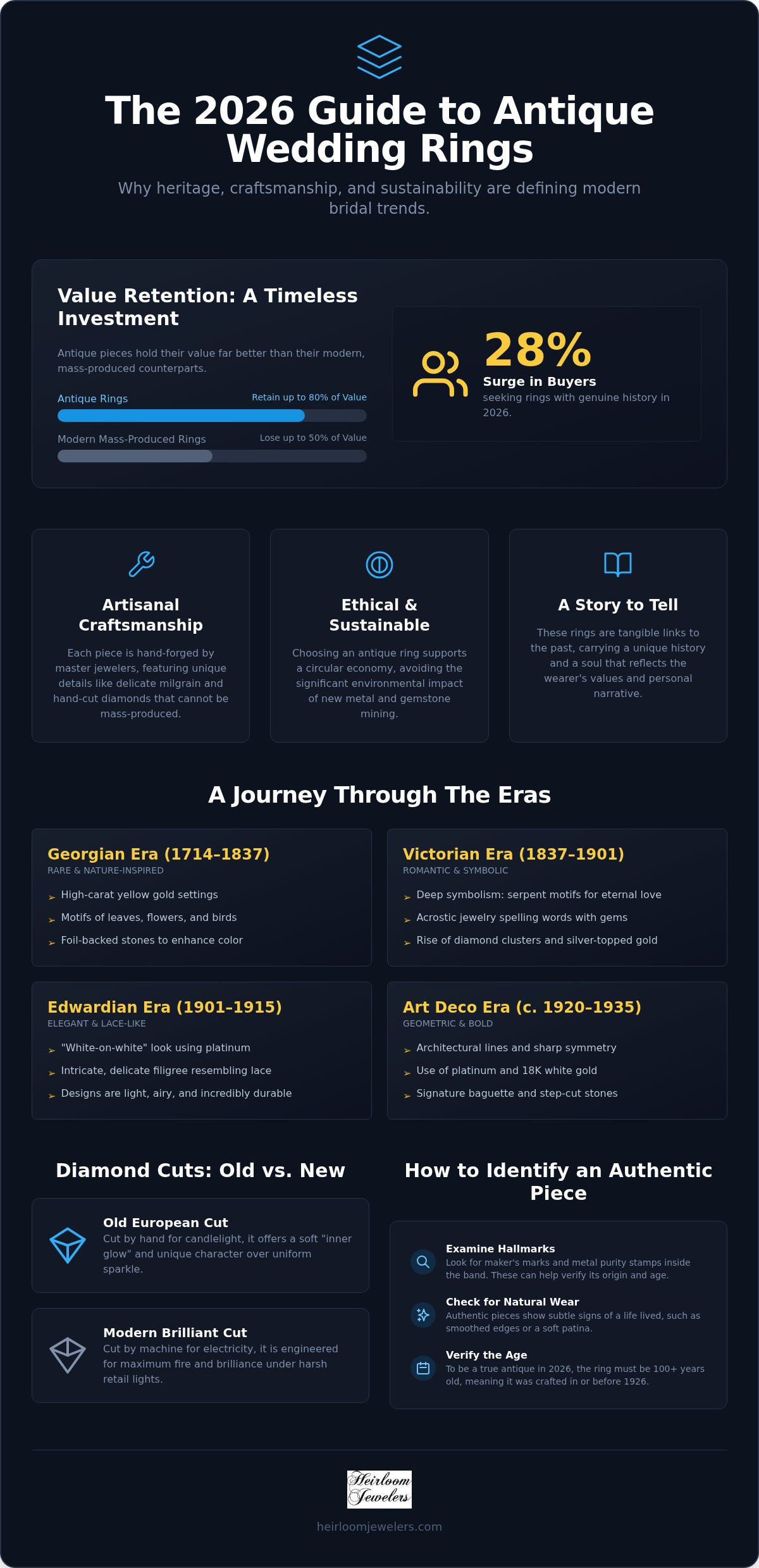
While modern, mass-produced jewelry often loses half its retail value the moment it leaves the showroom, authentic antique wedding rings currently retain up to 80% of their original purchase price. This striking stability explains why 2026 has seen a 28% surge in buyers seeking pieces with genuine history. You likely want a ring that tells a unique story and respects the planet, but the market is increasingly crowded with clever reproductions and confusing terminology.
We believe that choosing a symbol of your commitment should be a calm, informed experience rather than a stressful search. This guide will help you discover why antique wedding rings are dominating 2026 bridal trends and teach you how to identify true heritage pieces. We'll explore the distinct characteristics of different historical eras, clarify the differences between Old European and Modern Brilliant diamond cuts, and provide the hallmarks of quality you need to feel confident in your choice.
Key Takeaways
- Understand why antique wedding rings are the preferred choice for 2026 couples who value historical narrative and artisanal quality over modern mass production.
- Learn to distinguish between the romantic symbolism of the Victorian era and the bold, geometric precision of Art Deco designs.
- Identify the unique light performance and structural hallmarks of Old European and Rose cut diamonds compared to modern brilliant cuts.
- Discover how to verify a piece's age by examining metal purity hallmarks and natural wear patterns on the band.
- Gain confidence in the investment potential and environmental sustainability of choosing a pre-owned heritage band.
The Resurgence of Antique Wedding Rings in 2026
The bridal market has undergone a significant transformation. Couples are moving away from the uniform look of mass-produced showroom rings. They're seeking one-of-a-kind pieces like antique wedding rings instead. This shift is largely driven by the "Quiet Luxury" movement. It's an aesthetic that prioritizes understated elegance and genuine history over flashy, modern trends.
The Appeal of One-of-a-Kind Craftsmanship
Sustainability: The Ethical Choice for Modern Brides
Environmental concerns are at the forefront of 2026 bridal trends. The ecological impact of newly mined metals and gemstones is substantial. By choosing estate jewelry, you're supporting a circular luxury economy. This choice avoids the need for new mining. It's a responsible way to celebrate a commitment. With gold prices reaching the $4,000 to $5,000 range per ounce this year, antique pieces also offer a sense of enduring value. They represent a symbol of love that respects both history and the planet.
Defining the Eras: From Georgian Sentimentalism to Art Deco Boldness
To be classified as a true antique in 2026, a piece must have been crafted in or before 1926. This century-long requirement ensures that antique wedding rings possess the distinct artisanal techniques and historical soul of their time. Georgian rings (1714–1837) are among the rarest treasures. They're often recognized by their high-carat yellow gold and nature-inspired motifs like leaves or floral sprays. These early pieces were frequently backed with foil to enhance the stone's color, a technique that requires careful preservation today.
The Victorian era (1837–1901) brought a shift toward deep romantic symbolism. Queen Victoria’s own snake-style engagement ring sparked a trend for serpent motifs, representing eternal love. This period also saw the rise of diamond clusters and the use of colorful gemstones to convey hidden sentiments. As we moved into the Edwardian period (1901–1915), the introduction of the oxyacetylene torch allowed for the "white-on-white" look. Jewelers used delicate platinum filigree to create lace-like patterns that appear weightless yet remain incredibly durable.
The Sophistication of Art Deco Wedding Bands
Art Deco remains the most sought-after vintage style in 2026. This era is defined by geometric precision and bold symmetry. When identifying the hallmarks of art deco jewelry, look for the architectural use of platinum and 18K white gold. These metals provided the strength needed for the era’s signature sharp lines and baguette-cut stones. Market data indicates that Art Deco pieces have been appreciating by 15-20% annually, making them as much of a financial asset as an emotional one.
Victorian Symbolism in Modern Unions
Victorian antique wedding rings often contain hidden layers of meaning. Acrostic jewelry was a popular trend where the first letter of each gemstone spelled out a word like "DEAREST" or "ADORE." These 19th-century antique rings also showcased a fascinating transition in metallurgy. You'll often find mixed metals, such as silver-topped gold, which was used before platinum became the standard for diamond settings. This era’s focus on sentimentality offers a profound way to personalize a modern wedding ceremony.
If you're drawn to the structured elegance of the 1920s, viewing an authenticated vintage platinum diamond engagement ring allows you to appreciate this historical craftsmanship firsthand.
Old European Cuts vs. Modern Brilliance: A Technical Analysis
The visual appeal of antique wedding rings often centers on the specific character of the center stone. Before the development of modern laser technology, diamond cutters relied on their eyes and the steady glow of candlelight. This manual approach prioritized "fire," which refers to the flashes of colored light, over the white-light return favored by modern standards. While modern brilliant cuts are scientifically engineered for maximum reflection, they can feel clinical. Historic cuts possess a moody personality that reflects the era of their creation.
The Rose Cut remains a highly distinctive choice. Dating back to the 1500s, it features a flat base and a faceted, domed top that resembles an opening rosebud. It does not have the deep pavilion found in later cuts. This allows the stone to sit low and elegant against the skin. It offers a quiet alternative to the high-intensity flash found in 21st-century jewelry.
The Anatomy of a Heritage Diamond
Identifying an authentic antique diamond requires a look at its specific proportions. Heritage stones typically feature high crowns and small tables. One of the most reliable hallmarks of an antique stone is the culet. In modern diamonds, the culet is a sharp point where the facets meet at the bottom. In older stones, the culet is a flat facet. When you look through the top of the diamond, this appears as a small, dark circle in the center. The Old European cut is the predecessor to the modern round brilliant, perfected between 1890 and 1930. Because these stones were cut with more vertical depth, they often have a more substantial presence on the finger than modern stones of the same carat weight.
Light Performance: Candlelight vs. Showroom Lighting
Antique diamonds were designed to perform in low-light environments. Modern showrooms use high-intensity LED lights to force a surface sparkle. Heritage stones rely on an "inner fire" that seems to glow from within. This difference in light performance is a frequent topic of debate among collectors. While modern stones offer a uniform brilliance, antique cuts provide a soft, broad flash of light that changes as the wearer moves. This unique character is why antique diamond earrings are frequently sought to complement antique wedding rings. Using stones from the same era ensures a consistent light performance across a bridal suite, maintaining the warm and authentic glow of the original craftsmanship.
The Investment Value of Authentic Heritage Wedding Bands
Modern retail jewelry often experiences a steep decline in resale value the moment it leaves the showroom. In contrast, authentic heritage jewelry represents a more stable financial choice. Market data from 2026 shows that antique pieces retain an average of 70 to 80% of their original purchase price. Mass-produced modern rings typically retain only 40 to 50%. This discrepancy is rooted in rarity. When you choose antique wedding rings, you're acquiring a finite resource. These pieces cannot be replicated with the same historical provenance or artisanal soul.
The secondary market places a high premium on "signed" pieces from prestigious design houses. Provenance acts as a multiplier for value. With gold prices reaching the $4,000 range per ounce in mid-2026, the intrinsic metal value of these rings has never been higher. Solid 18K gold currently holds a melt value of approximately $103 per gram. However, high-quality antique pieces are often priced at double their intrinsic metal value because of their historical significance and craftsmanship.
Platinum vs. White Gold in Antique Settings
Metal choice significantly impacts both the durability and the investment profile of a ring. Platinum was introduced as a jewelry standard during the Edwardian era. It's favored for its incredible strength and natural white hue that never fades. As we moved into the 1920s, 18K white gold became the hallmark of Art Deco elegance. It provided a slightly more accessible but equally sophisticated alternative. Both metals are excellent for daily wear, though platinum’s density offers superior protection for rare stones. These materials have proven their longevity over a century of use.
The Market for Rare Gemstones
While diamonds remain a staple, 2026 has seen a surge in demand for vibrant colored gemstones in bridal sets. Sapphires, emeralds, and peridot offer a distinctive aesthetic that modern mining struggles to match. Most modern stones undergo heavy heat treatments or artificial enhancements. Antique bands often feature untreated, natural gemstones that are increasingly scarce. The Lugano Emerald & Diamond Necklace 18K White Gold serves as a prime example of how high-value estate pairings maintain their allure through superior stone quality. Choosing a ring with a natural, historic gemstone ensures your piece remains a standout asset in any collection.
If you're ready to secure a piece of history, you can explore our curated collection of authenticated estate fine jewelry today.
How to Identify and Authenticate Antique Wedding Rings
Authenticating antique wedding rings requires a methodical eye and a respect for historical detail. Start by scrutinizing the hallmarks. A hallmark is a legal mark stamped on gold or platinum to certify its standard of purity. These stamps identify the metal content and often the city of origin or the specific year of manufacture. Next, examine the wear patterns on the band. True antiques exhibit natural smoothing where the ring has rested against another band for decades. Artificial aging often looks forced or inconsistently scratchy. Then, analyze the diamond cut under a jeweler's loupe. You're looking for the slightly irregular facet junctions that prove a stone was cut by hand. Machine-cut stones are too precise. For significant diamonds, request independent certification from the GIA or EGL. Finally, work with a specialist. Choosing vintage wedding bands is easier when you have a trusted curator to guide you.
Decoding Historical Hallmarks
British and European hallmarks provide a rich chronological record. A Victorian ring might feature a leopard's head for London or an anchor for Birmingham. These marks were struck with a physical die. This process often leaves a slight halo or displacement of metal around the mark. Modern reproductions often use laser engraving. These marks are perfectly flat and lack the depth of a traditional strike. If a hallmark looks too clean or perfectly centered on a thin band, it warrants closer inspection. Authentic marks show the same gentle wear as the rest of the piece.
The Red Flags of Modern Reproductions
Modern manufacturing leaves distinct red flags that a knowledgeable curator can spot immediately. Perfect symmetry and laser-sharp edges are common signs of modern casting. Antique pieces were hand-finished. They possess a soft, organic feel that machines cannot replicate. Another indicator is the patina. This is the natural darkening that occurs in the deep crevices of filigree or engraving. Modern "antique-style" rings often use chemical washes to mimic this look. These washes appear flat and gray. Authentic patina has a rich, dark luster that develops over a century. Heirloom Jewelers focuses exclusively on authenticated, pre-owned items. We exclude mass-produced imitations. This ensures every piece we curate is a genuine artifact of its era.
Securing a Legacy for Your Future
Choosing a ring is a significant decision that balances personal aesthetics with enduring value. We've explored how the distinct artistry of the Art Deco and Victorian eras offers a unique narrative that modern manufacturing cannot duplicate. By understanding the technical nuances of Old European cuts and the importance of historical hallmarks, you can navigate the secondary market with clarity. These pieces represent a commitment to both your partner and the preservation of artisanal history.
Antique wedding rings aren't just symbols of love; they're sustainable investments in craftsmanship. At Heirloom Jewelers, we act as reliable guides for those seeking authenticated 18K white gold and platinum estate pieces. Our specialization in Old European cut diamonds ensures that every find meets the highest standards of quality and provenance. We provide quiet confidence in every authenticated historical find we curate. Explore our curated collection of authenticated antique wedding rings at Heirloom Jewelers. We invite you to find a piece that resonates with your personal story and carries the elegance of a true heritage treasure.
Frequently Asked Questions
What is the difference between an antique and a vintage wedding ring?
An antique wedding ring must be at least 100 years old to carry that specific classification. In 2026, this means the piece was crafted in or before 1926. Vintage rings are typically between 20 and 100 years old. This distinction is vital for collectors. True antiques often possess unique hand-forged characteristics that were lost during the transition to more industrial manufacturing methods later in the 20th century.
Are antique wedding rings durable enough for everyday wear?
Most antique wedding rings are remarkably durable because they were crafted from high-quality solid metals like platinum and 18K gold. These pieces have already survived a century of wear, which proves their structural integrity. However, delicate filigree or very thin bands may require a gentle touch. We recommend regular inspections to ensure prongs remain secure and the metal hasn't thinned to a point where it risks snapping under daily pressure.
How do I clean and care for a 100-year-old platinum ring?
Cleaning a 100-year-old platinum ring is a straightforward process you can perform safely at home. Use a solution of warm water and a few drops of mild, fragrance-free dish soap. Soak the ring for fifteen minutes and gently scrub the setting with a soft-bristled toothbrush. Avoid ultrasonic cleaners for older pieces. The vibrations can loosen stones in aged settings. Always dry the metal thoroughly with a soft, lint-free cloth.
Can an antique wedding band be resized without losing its value?
Most antique bands can be resized by a specialist without compromising their historical value. However, rings with continuous patterns or delicate engravings around the entire shank present a greater challenge. A skilled jeweler will match the metal alloy and carefully blend the seam to maintain visual continuity. It's essential to preserve any original hallmarks located on the interior of the band during this process to maintain the piece's documented provenance.
Why are Old European cut diamonds more expensive than modern ones?
Antique diamonds can be 10-20% less expensive per carat than modern round brilliant cuts, but their overall value is rising due to rarity. Old European cuts are a finite resource. They aren't being produced anymore. This scarcity, combined with the growing demand for heritage styles, makes them a strong investment. You're acquiring a hand-cut artifact with a unique personality that modern, machine-cut stones simply cannot replicate in a lab.
What should I look for in a hallmark on a Victorian-era ring?
When examining a Victorian-era ring, look for small, stamped symbols on the inner band. Common marks include a crown for gold purity or a leopard’s head for London assay offices. You might also find a date letter which indicates the exact year the piece was tested. Authentic Victorian hallmarks show a level of wear consistent with the age of the ring. They usually appear softened rather than having the crisp edges of modern engravings.
Is it ethical to buy estate jewelry instead of new diamonds?
Buying estate jewelry is widely considered the most ethical choice for modern couples. Choosing a pre-owned ring supports a circular economy and eliminates the environmental impact associated with new mining operations. There's no additional carbon footprint or habitat destruction involved in the purchase. It allows you to enjoy a luxury item while maintaining planetary responsibility. Every antique ring is a recycled treasure that preserves the beauty of the past without harming the future.
Can I find an antique wedding ring that matches a modern engagement ring?
You can certainly find an antique wedding ring that complements a modern engagement ring. Many couples choose to mix eras to create a unique, curated look. A simple Edwardian platinum band can provide a sophisticated contrast to a modern solitaire. The key is to match the metal color and the band's profile height. This ensures the rings sit comfortably together on the finger while celebrating a blend of contemporary style and historical craftsmanship.