
A certified Type A untreated vintage jadeite necklace can command a premium of over 1,000% compared to chemically treated stones. This staggering value gap defines the high-stakes world of estate jewelry. You likely appreciate the deep luster and cultural weight of vintage jade necklaces, yet the market is often clouded by B-grade resins and modern imitations. It's natural to feel hesitant when distinguishing between a true heirloom and a clever chemical treatment. We understand that you want a piece that retains its value and historical integrity.
This guide provides the clarity you need to acquire these pieces with absolute confidence. You'll learn to navigate the complexities of the secondary market, ensuring your next acquisition is both a wearable history lesson and a sound investment. We will explore the mineralogical differences between Jadeite and Nephrite, the critical importance of modern lab certification, and how to identify the hallmark styles of the Art Deco era. By the end, you'll have the expertise to select a piece that stands the test of time.
Key Takeaways
- Distinguish between Jadeite and Nephrite to understand the rarity and market value of your piece.
- Learn why only Type A untreated jade belongs in a fine estate collection and how to avoid resin-treated stones.
- Recognize era-specific design elements, such as Art Deco geometric settings, that help date and authenticate vintage jade necklaces.
- Prioritize professional gemological reports over at-home tests to ensure material and historical authenticity.
- Discover how expert curation preserves the historical significance and long-term value of pre-owned fine jewelry.
The Enduring Appeal of Vintage Jade Necklaces
Vintage jade necklaces represent a unique intersection of geological rarity and human history. In the context of fine estate jewelry, a piece is typically classified as vintage once it surpasses the fifty-year mark. These necklaces are not merely accessories. They are authenticated artifacts that carry the aesthetic preferences and cultural values of previous generations. From the imperial court traditions of the Qing Dynasty to the geometric boldness of 1920s Paris, jade has remained a constant symbol of status and longevity. It is a stone that transcends fleeting fashion cycles.
Choosing estate pieces is a deliberate act of sustainability. By acquiring pre-owned jewelry, you preserve a piece of history while avoiding the environmental impact associated with modern mining. The concept of heritage is central to this pursuit. The value of a stone often stems as much from its provenance and the era of its setting as it does from its gemological grade. This historical narrative creates an emotional connection that mass-produced items cannot provide.
Why Collectors Prioritize Estate Jade
Collectors often seek out older pieces for their distinct character. Unlike modern mass-produced items, vintage jade necklaces frequently feature hand-carved details and unique patinas that develop over decades of careful wear. Understanding the mineralogical differences between jadeite and nephrite is essential for any serious enthusiast. While both are prized, jadeite became particularly popular in the West during the Art Deco movement. During this time, European houses paired translucent green jade with platinum and diamonds. These historical combinations are difficult to replicate today. Natural, untreated jade is increasingly rare in the contemporary market, making existing estate pieces highly sought after.
The Investment Value of Heritage Pieces
A fine jade necklace serves as a tangible hard asset. Its value is anchored by both the material quality and the historical significance of its design. Provenance plays a vital role in this evaluation. A piece with a documented history or era-specific hallmarks often commands a higher premium in the secondary market. This is why heritage jewelry continues to attract those who view their collection as a legacy. These items are designed to be passed down. They retain their allure because they represent a standard of craftsmanship that prioritized longevity over temporary trends. Investing in a vintage piece ensures you own a slice of history that maintains its worth across generations.
Jadeite vs. Nephrite: Understanding Material Excellence
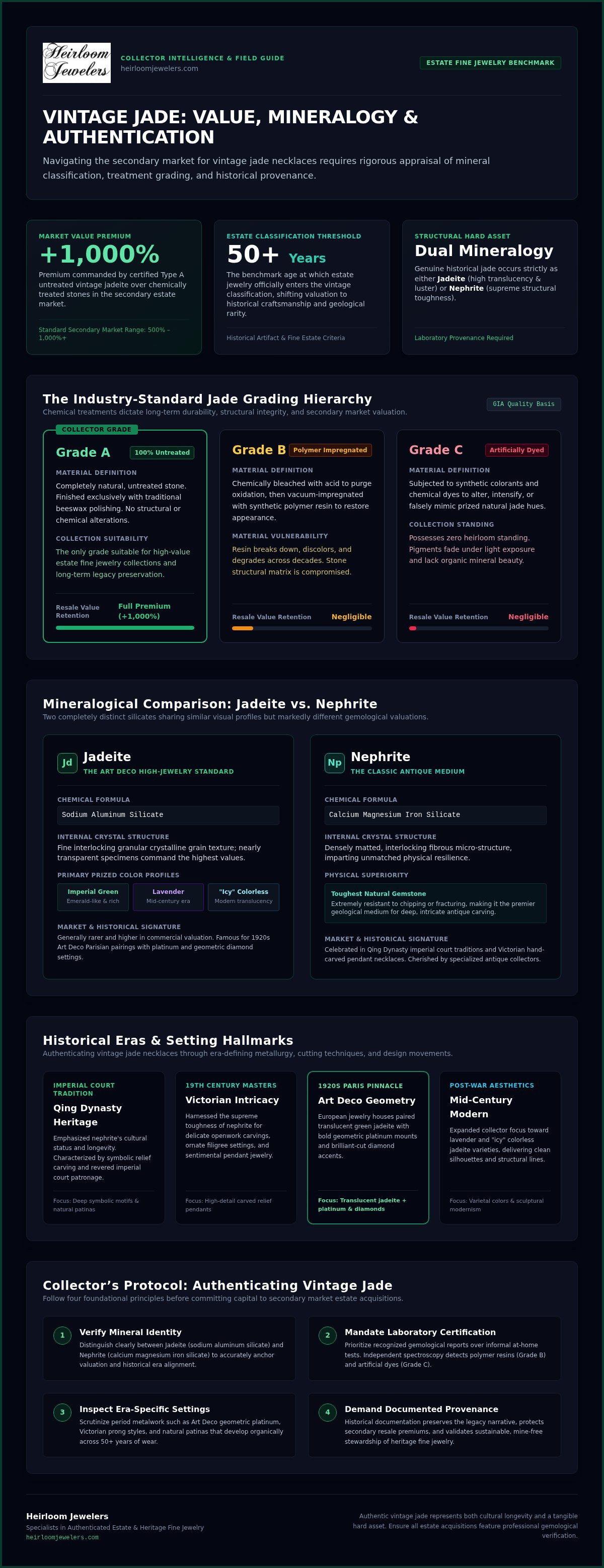
When evaluating vintage jade necklaces, collectors often encounter two distinct minerals: jadeite and nephrite. While they share a similar appearance, their chemical compositions and physical properties differ significantly. Jadeite is a sodium aluminum silicate, while nephrite is a calcium magnesium iron silicate. These mineralogical differences are subtle to the naked eye but profound in terms of valuation. Jadeite is generally rarer and more valuable, but high-quality nephrite has its own dedicated following among antique enthusiasts.
To curate a fine collection, you must understand the industry-standard grading system for jade.
- Grade A: Natural, untreated jade. It has only been polished with traditional beeswax. This is the only grade that belongs in a high-value estate collection.
- Grade B: Chemically bleached to remove oxidation and then vacuum-impregnated with polymer resin. Over time, this resin can discolor or degrade.
- Grade C: Artificially dyed to enhance or change the stone's color.
Jadeite: The Gem of the Art Deco Era
Jadeite rose to prominence in the early 20th century as the "gold standard" for high-end jewelry. Its popularity peaked during the Art Deco era when its vibrant colors provided a striking contrast to platinum and diamonds. Collectors prioritize "Imperial Green," which is a rich, emerald-like hue with high translucency. According to GIA jade quality factors, the most valuable jadeite is nearly transparent with a fine, interlocking grain texture. Beyond green, vintage jade necklaces from the mid-century era often feature lavender or "icy" colorless jadeite, which offers a sophisticated, modern aesthetic for collectors.
Nephrite: The Classic Choice for Antique Pendants
Nephrite is celebrated for its legendary toughness. Its interlocking fibrous structure makes it the toughest natural gemstone, which is why it was the ideal medium for the intricate carvings found in Victorian jewelry. It possesses a subtle, waxy luster rather than the glassy shine of jadeite. High-quality nephrite is often found in "spinach green" or the highly prized "mutton fat" white variety. While it doesn't reach the astronomical prices of Imperial jadeite, its durability and historical use in protective amulets make it a staple for those who appreciate antique craftsmanship. If you're looking for a piece with deep historical resonance, you can explore an authenticated estate collection to see these material differences firsthand.
Recognizing Era-Specific Artistry in Estate Jade
The allure of vintage jade necklaces often lies in the harmony between the gemstone and its historical setting. While the gemstone properties of jadeite and nephrite dictate the durability and luster of the stone, the metalwork serves as a chronological fingerprint. Collectors analyze these settings to verify authenticity. Techniques like milgrain, which consists of tiny beads of metal along an edge, or delicate wire filigree are hallmarks of specific periods. These details were traditionally executed by hand. They offer a level of precision and character that modern casting cannot replicate.
The cut of the jade also provides significant clues regarding its age. Victorian and earlier pieces frequently showcased intricate, symbolic carvings. These motifs often drew from traditional Chinese mythology, such as bats representing happiness or lotus flowers signifying purity. By the mid-20th century, the preference shifted toward smooth, polished cabochons or flat, geometric plaques. These stones were rarely set alone. They were typically accompanied by era-favored accents like seed pearls in the late 19th century or old European cut diamonds in the early 20th century. This combination of materials helped to elevate jade from a cultural artifact to a staple of fine Western jewelry.
Art Deco Jade: Geometry and Contrast
In the 1920s, jade became a central element of the Orientalism trend that swept through European design houses. Jewelers utilized platinum and white gold to provide a cool, sharp contrast to the vivid green of the stone. This era favored clean lines and architectural symmetry. Authentic art deco jewelry often integrated jade into bold, geometric patterns, sometimes pairing it with black onyx or red coral for a striking visual effect. The focus was on the stone as a focal point within a structured, modern frame.
Victorian and Edwardian Jade Designs
Earlier designs leaned toward a softer, more organic aesthetic. Victorian jewelry typically paired deep green nephrite with rich yellow gold, emphasizing warmth and sentimentality. These pieces often functioned as tokens of affection or protection. While jade was frequently featured in antique rings and brooches, necklace pendants from this time often displayed delicate floral carvings. Edwardian artisans later introduced milgrain borders and lace-like platinum work, often incorporating small diamonds or seed pearls to create a sense of airy elegance around the central stone.
The Collector’s Checklist for Authenticating Jade
Evaluating vintage jade necklaces requires a disciplined approach. Many enthusiasts rely on anecdotal "at-home" tests, but these methods often lack accuracy. Some, like the scratch test, can permanently damage a high-value stone. Professional authentication remains the only way to ensure your acquisition is a genuine Grade A heirloom. A thorough evaluation focuses on the stone's internal structure, its thermal properties, and the integrity of its metal setting.
Visual and Physical Inspection
A jeweler’s loupe is your most valuable tool. When examining the stone, look for natural inclusions. Authentic jadeite often displays a fibrous or granular texture. In contrast, glass imitations or resin-treated pieces frequently contain perfectly spherical air bubbles. These are a clear signal of modern manufacturing. You should also observe the carving. Hand-tooling from the Art Deco or Victorian eras typically shows slight variations in depth and symmetry. Modern machine carving often appears too uniform and lacks the soul of a hand-finished piece. Finally, note the temperature. Real jade has high thermal conductivity. It should feel cold to the touch and take several seconds to warm against your skin.
Evaluating the Setting and Provenance
The metalwork acts as a chronological anchor for the gemstone. You must inspect the chain and clasp for period-correct hallmarks. For example, platinum pieces from the early 20th century should feature specific stamps that align with that era's standards. It is also common to find "married" pieces. This occurs when a vintage stone is placed into a modern setting, or vice versa. An experienced estate jeweler can identify these discrepancies by looking for signs of later repairs or inconsistent metal patinas. When sourcing vintage jade necklaces, documentation is the final piece of the puzzle. For high-value jadeite, a report from a major lab like the GIA is essential. These reports use FTIR spectroscopy to confirm the absence of polymer impregnation, providing the transparency you need for a secure investment.
Building a collection based on material truth is a rewarding pursuit. If you are ready to find a piece with verified history and quality, you can view our authenticated collection of fine estate jewelry.
Curating Your Collection with Heirloom Jewelers
Curating a fine jewelry collection requires a partner who values history as much as you do. Heirloom Jewelers functions as a specialized boutique dedicated to the acquisition and preservation of authenticated estate finds. We recognize that vintage jade necklaces are more than mere ornaments. They are wearable legacies. Our commitment to transparency ensures that every piece in our inventory is evaluated for material integrity and historical significance. By choosing authenticated vintage over modern mass-produced items, you acquire a unique asset that carries its value forward into the future.
The Heirloom Jewelers Standard
Our curation process is methodical and steady. We focus exclusively on pre-owned items that offer a documented history or clear era-specific hallmarks. This expertise in the secondary fine jewelry market allows us to identify rare gemstones that others might overlook. We don't offer mass-produced jewelry or custom manufacturing services. Instead, we prioritize the unique craftsmanship found in pieces like a Vintage Platinum 0.5 Carat Diamond Engagement Ring or a Lugano Emerald & Diamond Necklace 18K White Gold. This focused approach ensures that every item we present meets a high standard of lasting quality. You can trust that our descriptions are functional and transparent, providing the essential details needed for a confident purchase.
Finding Your Next Statement Piece
Navigating a high-value secondary market can be complex, but it doesn't have to be stressful. We provide personal attention to every client, whether you are visiting us in person or browsing our national collection online. Our inventory of estate gemstone jewelry is constantly evolving as we discover new rarities. We invite you to explore our selection of vintage jade necklaces and other historic treasures. You may also find interest in our curated collection of antique diamond earrings, which highlight the same level of artisanal cut and setting detail discussed throughout this guide. Each acquisition is handled with the hospitality and respect that a serious collector deserves. We act as a bridge between the past and your personal collection, ensuring the story of each piece continues with you.
Secure Your Piece of Wearable History
Acquiring fine estate jewelry is a deliberate journey into the past. You now have the essential tools to distinguish between jadeite and nephrite and the knowledge to insist on Type A untreated material for your collection. Authentic vintage jade necklaces offer a unique combination of geological rarity and artisanal metalwork that modern mass-production simply cannot replicate. By focusing on era-specific details and professional gemological reports, you ensure that your acquisitions remain a source of both beauty and lasting value. It's a rewarding process that prioritizes material quality over temporary trends.
We invite you to apply these insights as you browse our latest authenticated estate inventory. Our deep expertise in the secondary fine jewelry markets allows us to present rare, one-of-a-kind finds that have been carefully vetted for historical integrity and material excellence. Choosing a piece with a documented history is a commitment to craftsmanship that transcends generations. We're here to act as your reliable guide in finding an heirloom that truly resonates with your personal style and appreciation for heritage.
Explore Our Curated Collection of Authenticated Estate Jewelry
Frequently Asked Questions
How can I tell the difference between vintage jade and modern imitations?
Focus on material properties and setting. Modern imitations like glass or resin often contain air bubbles, which are visible under a loupe. Genuine jade has a fibrous or granular internal structure. Vintage jade necklaces also feature era-specific metalwork, such as hand-milgraining or specific hallmarks, that modern mass-production cannot replicate. Genuine pieces feel cold to the touch and possess a specific weight that imitations lack.
Is Jadeite more valuable than Nephrite in vintage jewelry?
Jadeite generally commands a higher market value due to its rarity and vibrant color range. While nephrite was prized for centuries for its toughness and waxy luster, jadeite became the "gold standard" during the Art Deco movement. Its emerald-green translucency is highly sought after by estate collectors. However, fine "mutton fat" white nephrite or exceptional antique carvings can still hold significant value within the secondary market.
What are the "Three Grades" of jade, and why do they matter for collectors?
The grades classify the level of treatment the stone has received. Grade A is natural and untreated, only polished with traditional wax. Grade B has been acid-bleached and polymer-impregnated, while Grade C is artificially dyed. For an estate collection, only Grade A is acceptable. Treated stones like Grade B and C lose their structural integrity and color over time, making them poor long-term investments for serious collectors.
Does the color of jade affect its value in estate necklaces?
Color is a primary driver of valuation. Imperial Green is the most valuable, characterized by a vivid emerald hue and high translucency. Beyond green, collectors seek out fine lavender, "icy" colorless, and even rare red or yellow jadeite. In nephrite, a pure white "mutton fat" color is the most prized. Evenness of color and the absence of distracting mottling significantly influence the final market price of vintage pieces.
How should I care for a vintage jade necklace to preserve its value?
Gentle maintenance is essential for preserving historical integrity. Avoid ultrasonic cleaners or steam, as these can damage the stone's surface or weaken older metal settings. Clean your necklace with a soft, lint-free cloth and lukewarm, soapy water if necessary. Store it separately from harder gemstones like diamonds to prevent scratches. Regular inspections by a professional jeweler ensure that clasps and prongs remain secure for safe wear.
What eras are most famous for jade jewelry design?
The Art Deco era is arguably the most famous for jade design. During this period, European jewelers paired vibrant jadeite with platinum and geometric diamond accents. The Victorian era also featured significant jade work, often using deep green nephrite in yellow gold settings with symbolic carvings. Mid-century designs later popularized "icy" and lavender jadeite, moving toward more minimalist and modern aesthetic frames for the stones.
Should I only buy vintage jade that has a GIA certification?
Certification is highly recommended for high-value acquisitions. A GIA report provides an objective analysis of the stone's species and confirms the absence of polymer treatments. While some smaller antique pieces may not always come with reports, significant investments should be backed by laboratory verification. This documentation ensures transparency and protects the resale value of your collection. It provides peace of mind regarding the material's natural status.
Why is natural, untreated jade so rare in the vintage market?
Much of the jade circulating in the modern market has undergone some form of enhancement. Late 20th-century techniques made it easier to improve the appearance of lower-quality stones through bleaching and resin impregnation. Finding vintage jade necklaces that have remained entirely untreated for decades is a challenge. This rarity is exactly why authenticated, Grade A estate pieces are so highly valued by knowledgeable collectors and enthusiasts.